
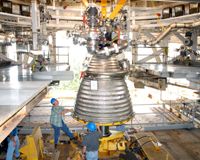
On Dec. 18, NASA began testing core components of a rocket engine from the Apollo era on the A-1 Test Stand at NASA's John C. Stennis Space Center near Bay St. Louis, Miss.
Data from the tests will help NASA build the next generation engine that will power the nation's new Ares launch vehicles on voyages that will send humans to the moon.
The test was on the engine's powerpack — a gas generator and turbopumps that perform the rocket engine's major pumping and combustion work.
During the test, engineers ran liquid oxygen and liquid hydrogen through the powerpack, monitoring its ducts, valves and lines to verify the tightness of seals in the oxidizer lines and pumps.
Engineers also verified accuracy of the chill procedure and determined the amount of time required to chill the pumps. Initial indications are all test objectives were met with no anomalies noted.
NASA's Marshall Space Flight Center in Huntsville, Ala., manages the J-2X upper stage engine for NASA's Constellation Program, based at NASA's Johnson Space Center in Houston. Under a contract awarded in July 2007, Pratt and Whitney Rocketdyne Inc., of Canoga Park, Calif., will design, develop, test and evaluate the engine.
