
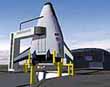
NASA yesterday completed its Record of Decision (ROD) on the X-33 Environmental Impact Statement (EIS), announcing it intends to proceed with the preferred X-33 flight test program as described in the Final EIS issued Oct. 3.
Signing of the decision document yesterday by Dr. Robert E.
Whitehead, NASA Associate Administrator for Aeronautics and
Space Transportation Technology, concludes a 12-month EIS
process of assessing the development and flight test of the
X-33, a subscale technology demonstrator prototype of a
Reusable Launch Vehicle.
All 15 test flights of the X-33 will be conducted from the
launch site at Haystack Butte on the eastern portion of Edwards
Air Force Base, CA, to landing sites at Michael Army Air Field,
Dugway Proving Ground, UT, and Malmstrom Air Force Base near
Great Falls, MT.
A third landing site, Silurian Lake, a dry lake bed near
Baker, CA, had been considered for use as a short-range landing
site. However, flights into Dugway¿s airfield some 450 miles
from Edwards better match the initial flight demonstration
requirements.
The X-33 environmental study considered issues such as
public safety, noise, impacts on general aviation, and effects
on biological, natural and other resources. Two launch sites
and five landing sites were evaluated for potential use. The
final decision on a flight test program was based on
programmatic, technical, and other considerations as well as
environmental factors. Overall, environmental impacts of the
program are expected to be low at all operational sites.
Now that the environmental process for the X-33 has been
completed, the next major program milestone is groundbreaking
for the launch facility at Edwards Air Force Base.
Construction crews are scheduled to begin work this week.
Construction is scheduled to be completed within a year.
The X-33 is being developed under a cooperative agreement
between NASA and Lockheed Martin Skunk Works, Palmdale, CA,
which began July 2, 1996.
NASA has budgeted $941 million for the X-33 program through
1999. Lockheed Martin will invest at least $212 million in the
X-33 program.
The X-33 is a sub-scale technology demonstrator prototype
of a Reusable Launch Vehicle, which Lockheed Martin has named
"Venture Star ™," and which the company hopes to develop
early in the next century. Through demonstration flights and
ground research, the X-33 will provide information needed for
industry to decide by the year 2000 whether to proceed to the
development of a full-scale, commercial single-stage-to-orbit
reusable launch vehicle.
– end –
The two-volume Final Environmental Impact Statement is available on the Internet here (approximately 1,025 pages with appendices):
A 1 Mbyte PDFn version of the 45-page executive summary is also
Print versions of the document are available for review in the
NASA Headquarters and Marshall Space Flight Center newsrooms.
Reuseable Launch Vehicle Archive at Spacer.Com
Rotary
