
North Korea fired a ballistic missile Sunday in an apparent bid to test the South's new liberal president and the US which have both signalled an interest in negotiations to ease months of tensions.
The missile flew more than 700 kilometres (435 miles) before landing in the Sea of Japan, South Korea's Joint Chiefs of Staff said. The US Pacific Command said it did not appear to be an intercontinental ballistic missile.
New South Korean President Moon Jae-In, who was inaugurated on Wednesday, slammed the test as a "reckless provocation" after holding an emergency meeting with national security advisors.
He said the government strongly condemned this "grave challenge to the peace and security of the Korean peninsula and the international community," his spokesman Yoon Young-Chan said.
Moon, unlike his conservative predecessors, advocates reconciliation with Pyongyang but warned Sunday that dialogue would be possible "only if the North changes its behaviour".
Moon had said in his inauguration speech that he was willing to visit Pyongyang "in the right circumstances" to defuse tensions on the peninsula, with Pyongyang and Washington exchanging hostile rhetoric.
"The North is apparently trying to test Moon and see how his North Korea policy as well as policy coordination between the South and the US will take shape," said Yang Moo-Jin, professor at the University of North Korea Studies in Seoul.
– 'Seeking leverage' –
The launch was also aimed at "maximising the North's political leverage" ahead of possible negotiations with the US, as Pyongyang and Washington both recently signalled they were open to talks, he added.
"The North wants to show before negotiations that their precious, powerful weapon is not something they would give up so easily," Yang said.
US President Donald Trump has threatened military action against the North but recently appears to have softened his stance, saying he would be "honoured" to meet the North's leader Kim Jong-Un under the right conditions.
Choe Son-Hui, a senior official at the North's foreign ministry handling its US policy, also said Saturday the North would be willing to hold talks with the US if the conditions are right.
Washington has been looking to China for help in reining in Kim and the missile test is likely to embarrass Beijing, which is hosting a summit Sunday to promote its ambitious global trade infrastructure project.
China, the isolated North's sole major ally and economic lifeline, has been reluctant to exert pressure to upset the status quo in Pyongyang and risk an influx of refugees from its neighbour.
– 'Fast progress' –
The latest test was also the North's first launch since a controversial US missile defence system deployed in the South became operational on May 2 and follows a failed April 29 ballistic missile test.
Japanese Prime Minister Shinzo Abe slammed the latest missile launch as "totally unacceptable" and a "grave threat" to Tokyo.
"We strongly protest against North Korea," he said.
The North has staged two atomic tests and dozens of missile launches since the start of last year in its quest to develop a missile capable of delivering a nuclear warhead to the US mainland.
Most experts have doubted that the North has developed an intercontinental ballistic missile (ICBM) with that range.
But many say the isolated nation has made a great progress in its nuclear and missile capabilities since Kim took power after the death of his father and longtime ruler, Kim Jong-Il, in 2011.
Yang said Sunday's launch showed "fast progress" in Pyongyang's missile capability.
The missile was fired from a site near the northwestern city of Kusong. A previous test at the same site in February sent a missile 500 kilometres, far less than Sunday's launch.
Chronology of North Korean missile development
Seoul (AFP) May 14, 2017 –
North Korea on Sunday test-fired a ballistic missile, the latest in a series of rocket and nuclear tests that have sent regional tensions soaring.
Here are key dates in its missile programme:
Late 1970s: Starts working on a version of the Soviet Scud-B (range 300 kilometres or 186 miles). Test-fired in 1984
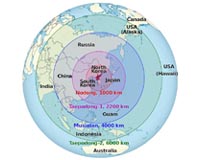
1987-92: Begins developing variant of Scud-C (500 km), Rodong-1 (1,300 km), Taepodong-1 (2,500 km), Musudan-1 (3,000 km) and Taepodong-2 (6,700 km)
Aug 1998: Test-fires Taepodong-1 over Japan as part of failed satellite launch
Sept 1999: Declares moratorium on long-range missile tests amid improving ties with US
July 12, 2000: Fifth round of US-North Korean missile talks ends without agreement after North demands $1 billion a year in return for halting missile exports
March 3, 2005: North ends moratorium on long-range missile testing, blames Bush administration's "hostile" policy
July 5, 2006: North test-fires seven missiles, including a long-range Taepodong-2 which explodes after 40 seconds
Oct 9, 2006: North conducts underground nuclear test, its first
April 5, 2009: North Korea launches long-range rocket which flies over Japan and lands in the Pacific, in what it says is an attempt to put a satellite into orbit. The United States, Japan and South Korea see it as a disguised test of a Taepodong-2
May 25, 2009: North conducts its second underground nuclear test, several times more powerful than the first
April 13, 2012: North launches what it has said is a long-range rocket to put a satellite into orbit, but it disintegrates soon after blast-off and falls into the ocean
December 12, 2012: North launches a multi-stage rocket and successfully places an Earth observational satellite in orbit
February 12, 2013: Conducts its third underground nuclear test
January 6, 2016: North conducts its fourth underground nuclear test, which it says was of a hydrogen bomb — a claim doubted by most experts
February 7, 2016: North Korea launches a satellite-bearing rocket, an operation widely seen as a covert ballistic missile test
March 9, 2016: Kim Jong-Un claims the North has successfully miniaturised a thermo-nuclear warhead
April 15, 2016: North Korea tries but fails to test-fire what appears to be a medium-range missile on the birthday of founding leader Kim Il-Sung
April 23, 2016: North test-fires a submarine-launched ballistic missile
July 8, 2016: US and South Korea announce plans to deploy an advanced missile defence system — the US THAAD (Terminal High Altitude Area Defense)
August 3, 2016: North Korea fires a ballistic missile directly into Japanese-controlled waters for the first time
August 24, 2016: Successfully test-fires a submarine-launched ballistic missile, in what it says is retaliation for large-scale South Korea-US military exercises
September 5, 2016: North Korea fires three ballistic missiles off its east coast as top world leaders meet at the G20 summit in China
September 9, 2016: Fifth nuclear test
October 15, 2016: An intermediate-range Musudan missile, theoretically capable of reaching US bases on Guam, is tested but explodes shortly after launch
February 12, 2017: North conducts test of ballistic missile which flies about 500 kilometres (310 miles) before falling into the Sea of Japan
March 6, 2017: North fires four ballistic missiles in what is says is an exercise to hit US bases in Japan. Three come down in waters that are part of Japan's exclusive economic zone
March 7, 2017: US begins deploying THAAD missile defence system in South Korea
March 19, 2017: North Korea says it has tested a new rocket engine
April 5, 2017: North Korea fires a ballistic missile into the Sea of Japan (East Sea), which the US says was an extended-range Scud missile
April 16, 2017: North Korea stages a failed missile test
April 29, 2017: North test-fires a ballistic missile which fails after a brief flight
May 2, 2017: THAAD anti-missile system goes operational in South Korea
May 14, 2017: North fires a ballistic missile which flies 700 kilometres before landing in the Sea of Japan.
NKorea might meet with US; Wants extradition of SK's spy chief
A senior North Korean diplomat said Saturday Pyongyang would be willing to hold talks with the United States if the conditions are right.
Choe Son-Hui, head of the foreign ministry's North America bureau, told reporters at Beijing's international airport that her country "will hold dialogue under right conditions" with President Donald Trump's administration.
She spoke as she was returni … read more
