
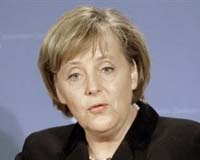
Chancellor Angela Merkel vowed Wednesday to uphold a government pledge to phase out nuclear power in Germany but said action was needed to secure the country's energy supply. Speaking in the midst of a Russian-Belarus row that has disupted Russian oil deliveries to Germany, Merkel said: "I will remain loyal to the government's programme, but I will say that those who want us to get out of nuclear power have to consider the consequences.
"And the consequence is that we will have to change our energy mix," she told a news conference here.
Merkel said she would like to see "constructive proposals" from those who support a move by Germany to abandon nuclear energy.
The debate about the wisdom of a nuclear phase-out in Germany by 2020 has been reignited by the current dispute between Russia and Belarus.
Moscow suddenly suspended oil deliveries westwards through the Druzhba pipeline, which crosses Belarus to the Czech Republic, Hungary, Germany, Poland and Slovakia.
Belarus is insisting that Russia pay a 45-dollar-per-tonne fee for oil transiting through the pipeline across its territory, but Moscow says the fee is illegal.
The dispute has hit Europe's supply of gas and oil from Russia and re-fuelled debate about the independence of Germany's energy supply in the future.
Late Tuesday, German Economy Minister Michael Glos called for an "urgent and necessary" re-think of the country's pledge to abandon nuclear power in view of the dispute between Russia and Belarus.
"Nuclear energy belongs to a balanced mix of different energy sources," Glos told the late evening "Tagesthemen" news programme on ARD public television.
"We don't want any one-sided dependencies," the minister said shortly before the European Commission in Brussels was to unveil a plan to strengthen EU unity on energy policy and to diversify sources of supply.
But Transport Minister Wolfgang Tiefensee insisted on Wednesday that there was no going back on the phase-out pledge.
It was Merkel herself who relaunched the debate on Monday evening when she said: "You have, naturally, to think about the consequences for the pull-out of nuclear power."
Merkel said the dispute between Belarus and Russia destroyed confidence in Russia as an energy supplier.
Germany currently has 17 nuclear power stations in operation, but the previous government under Gerhard Schroeder, a coalition of the Social Democrat SPD and environmentalist Green parties, decided to shut them down by 2020.
Environment minister Sigmar Gabriel told WDR radio on Wednesday that the best way for safeguarding Germany's independence in energy would be to develop renewable sources of energy.
earlier related report
German Minister Urges Review Of Block On Nuclear Energy
Berlin (AFP) Jan 10 – German Economy Minister Michael Glos called late on Tuesday for an "urgent and necessary" re-think of the country's pledge to abandon nuclear power in view of the current energy dispute between Russia and Belarus, which has hit Europe's supply of gas and oil from Russia.
"Nuclear energy belongs to a balanced mix of different energy sources," Glos told the late evening "Tagesthemen" news programme on ARD public television.
"We don't want any one-sided dependencies," the minister said shortly before the European Commission in Brussels was to unveil a plan to strengthen EU unity on energy policy and to diversify sources of supply.
It was Chancellor Angela Merkel herself who relaunched the debate on Monday evening when she said: "You have, naturally, to think about the consequences for the pull-out of nuclear power."
Merkel was referring to the current dispute between Russia and Belarus in which Moscow suddenly suspended oil deliveries westwards through the Druzhba pipeline, which crosses Belarus to the Czech Republic, Hungary, Germany, Poland and Slovakia.
Belarus is insisting that Russia pay a 45-dollar-per-tonne fee for oil transiting through the pipeline across its territory, but Moscow says the fee is illegal.
Merkel said that the dispute destroyed confidence in Russia as an energy supplier.
Germany currently has 17 nuclear power stations in operation, but the previous government under Gerhard Schroeder, a coalition of the Social Democrat SPD and environmentalist Green parties, decided to shut them down by 2020.
The pull-out has been the object of recurring debate ever since. But the latest energy dispute between Russia and Belarus has thrown the spotlight on Germany's dependance on Russian oil, triggering calls for a greater mix of different energy sources.
Environment minister Sigmar Gabriel told WDR radio on Wednesday that the best way for safeguarding Germany's independence in energy would be to develop renewable sources of energy.
Source: Agence France-Presse
