
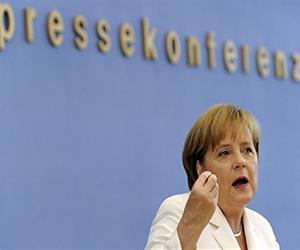
Chancellor Angela Merkel on Sunday dismissed angry calls by German business leaders to scrap a planned tax on nuclear energy production which they call a threat to investment.
Asked whether taxes on the nuclear energy sector amounting to 2.3 billion euros (2.9 billion dollars) per year would still be introduced, Merkel replied, "Of course," in an interview to air later Sunday on ZDF public television.
She said she assumed the tax would be in the form of a direct levy on nuclear power plants, in exchange for an extension of the reactors' lifetimes beyond a planned shutdown in around 2020 agreed by a previous government.
"We (the cabinet) proposed a tax on nuclear power plants and as long as there is no other proposal on the table, this is the tax that will come," she said.
Some 40 business leaders lashed out at the government in a full-page newspaper ad Saturday warning that the proposed tax on the country's 17 nuclear power plants would hamper investment in Europe's biggest economy during a nascent recovery.
While the environment ministry wants some of the revenue from a nuclear energy tax to go toward promoting renewable energies such as wind or solar power, Merkel said it would go toward balancing the budget.
Merkel underlined her centre-right government's commitment to slowing the phase-out of nuclear power agreed by her predecessor Gerhard Schroeder, arguing that Germany is not ready to do without the energy it supplies.
"I am firmly convinced that it is necessary to allow the nuclear power plants to run longer," she told ZDF.
Merkel's government aims to unveil a broad energy policy overhaul by the end of September, including a new plan for the nuclear phase-out.
earlier related report
EU commissioner backs mooted German nuclear tax
Berlin (AFP) Aug 21, 2010 –
European Union Energy Commissioner Guenther Oettinger said German energy companies should hand over to the state at least half their profits accrued from extending the life of nuclear power stations.
He was speaking in an interview with the daily Sueddeutsche Zeitung Saturday as German bosses and economic figures have lashed out at a government proposal to tax nuclear energy production.
"It's quite normal for nuclear groups to protest at the idea of a tax, but they should give the authorities a large part of the sizeable profits accruing from the (extended) operation of nuclear plants.
"I consider that at least 50 percent would be appropriate."
A letter printed Saturday as a full-page ad in German newspapers took aim at a mooted tax on nuclear plants that could raise 2.3 billion euros (2.9 billion dollars) per year for the state as it seeks to balance the public finances.
"A policy that consists of filling the budget by creating new energy taxes amounts to blocking important future investments," it said.
Among those who signed the letter were the heads of major power companies E.ON, RWE and Vattenfall.
The leaders of industrial giants BASF, Bayer and ThyssenKrupp added their names, as did heads of the retail group Metro, media group Bertelsmann and Germany's largest bank, Deutsche Bank.
Without being named directly, the leader of one major German company called the text a "warning shot for the government."
Chancellor Angela Merkel wants nuclear power plant operators to pay the tax in exchange for an extension of the plants' lifetimes, which is to end in around 2020 under the terms of a previous decision.
"A precipitate exit from nuclear power would destroy billions of euros in capital," the letter warned.
"We cannot give up for the time being on coal or nuclear energy if we want energy prices to remain affordable for all," it added.
Merkel's government aims to decide on its new energy policy by the end of September, and Oettinger said the argument should be settled quickly in order to focus on "other decisions which are at least as important."
These included research and investment in energy, including projects for huge solar power plants in the deserts of Africa and the Middle East.
Finance Minister Wolfgang Schaueble said late Friday that the purpose of a tax was to boost government finances rather than reinvest the cash in renewable energy resources, as sought by Environment Minister Norbert Roettgen.
However in her weekly videotaped message released Saturday, Merkel said that while the current need was for energy from different sources, including nuclear plants, the aim was "to enter the age of renewal energy as quickly as possible."
Share This Article With Planet Earth
