
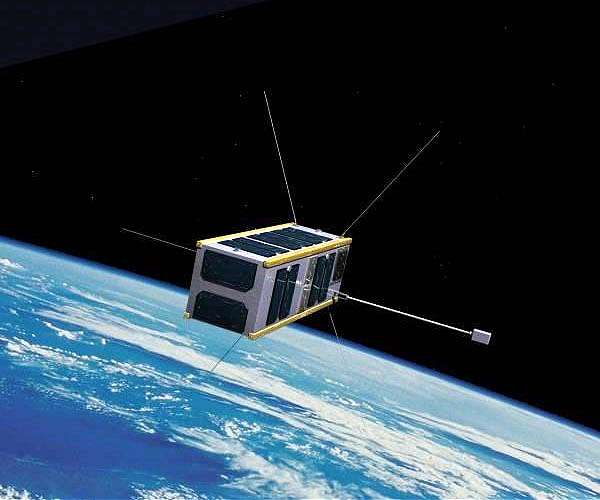
Building on the successful launch and deployment of its first two CubeSat Networked Communications Experiment (CNCE) Block 1 space vehicles last June, the Missile Defense Agency launched two CNCE Block 2 CubeSats May 25, 2022 aboard a SpaceX Falcon 9 rocket. Successful communications with both CubeSats was confirmed on May 31, 2022.
The new mission is a planned follow-on to the Block 1 success and supports the development of MDA's Hypersonic and Ballistic Tracking Space Sensor (HBTSS) and other MDA and DOD space efforts. Part of MDA's Nanosat Testbed Initiative (NTI), the CNCE program uses small, low-cost satellites to demonstrate networked radio communications between nanosatellites while in orbit.
"The CubeSat program provides a cost-effective way to test technology critical to the nation's missile defense system," said Vice Adm. Jon A. Hill, director, Missile Defense Agency. "Establishing reliable communications links between satellites in orbit means we can relay fire-control-quality adversary missile track data to the warfighter through our Command and Control, Battle Management, and Communications system, so we can engage and destroy those threats."
CNCE Block 2 will also test a new type of software-defined radio as well as demonstrate technology that supports space-based High Assurance Internet Protocol Encryption (HAIPE). The mission will last 90 days with provisions for a one-year extension.
Launched June 30, 2021 also on a 90-day mission with a potential one-year extension, MDA retired the first two CNCE Block 1 CubeSats before the Block 2 launch, and those actions will bring them down into the Earth's atmosphere where they will burn up harmlessly.
