
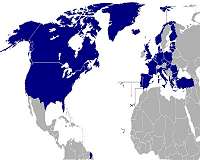
US Defense Secretary Jim Mattis assailed Russian President Vladimir Putin on Friday, accusing him of attacking western democracy and trying to break up NATO.
Mattis's remarks came just hours after President Donald Trump repeated his assertion that Russia should be invited back into the G7 group of industrialized nations, from which it was kicked out for annexing Crimea in 2014, an event he blamed on his predecessor Barack Obama.
"For the first time since World War II, Russia has been the nation that has redrawn international borders by force of arms in Georgia and Ukraine, while pursuing veto authority over their neighbors' diplomatic, economic and security decisions," Mattis said at a US Naval War College graduation ceremony in Rhode Island.
"Putin seeks to shatter NATO. He aims to diminish the appeal of the western democratic model and attempts to undermine America's moral authority."
The Pentagon chief added that Putin's actions were designed not to directly challenge America's military prowess, but rather "to undercut and compromise our belief in our ideals."
Earlier Friday, Trump said Russia should be invited back to the negotiating table with other industrialized countries.
"A few years ago, Putin was in what was called the G8. I think it's better to have Russia in, than to have Russia out," Trump told reporters.
"Because just like North Korea, just like somebody else, it's much better if we get along with them than if we don't. So it's possible."
Stoltenberg, Merkel eye NATO 'unity' despite G7 bust-up
Berlin (AFP) June 15, 2018 –
NATO chief Jens Stoltenberg and German Chancellor Angela Merkel voiced confidence Friday that a summit of alliance leaders in July will show "transatlantic unity" despite last week's acrimonious G7 meet.
The Group of Seven summit gathering of top industrialised democracies finished in disarray as US President Donald Trump abruptly rejected its consensus statement and bitterly attacked Canada's Justin Trudeau.
The G7 bust-up has raised fears of an end to the transatlantic relationship, at a time when Trump has also angered EU allies by imposing punitive tariffs on billions of euros worth of European goods.
However, Stoltenberg said that when leaders of the transatlantic defence alliance gather in July, the "United States and President Trump will once again reconfirm their commitment to transatlantic unity and to NATO lines".
This was "partly because this has been clearly stated by President Trump last time I met him in Washington, but also because we see this on the ground with concrete actions," he said in Berlin after talks with Merkel.
Since Trump took office in January last year, Washington has pumped 40 percent more funds into boosting its military presence in Europe, said the NATO chief.
"I expect us to make a decision on increased readiness, on more joint activities like in fighting terrorism, so I'm confident that (Trump) will come to Brussels in July… and that together we will send a strong message of NATO unity," said Stoltenberg.
Merkel echoed his optimism, saying that the meeting would yield "firm results".
"I think that in spite of existing differences in opinions, we will have a very constructive summit during which we will also make important decisions," she said.
Trump has repeatedly lashed European allies for failing to meet a commitment to spend two percent of GDP on defence by 2024, with economic powerhouse Germany coming in for particular criticism.
Merkel last week said German defence spending would rise to 1.5 percent of GDP by 2025.
While still short of the magic two percent, this would represent an 80 percent increase over a decade.
Stoltenberg lauded Germany for the hike but urged Berlin to go further.
"I encourage Germany to do more because Germany is the biggest economy in Europe, so it really matters what Germany does," he said.
"We need German leadership in this issue. We're moving in the right direction, but we still have a long way to go."
