
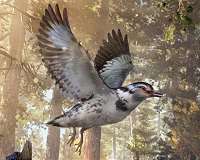
In a new study, researchers in Britain used math models developed by famed mathematician Alan Turing to figure out why flocks of long-tailed tits separate themselves into different parts of their habitat.
Many birds form what are called home range patterns, but scientists have struggled to explain why non-territorial passerine segregate themselves.
For the study, scientists at the University of Sheffield tracked the movements of long-tailed tits across the woodlands they called home. After collecting enough data for patterns to emerge, researchers used Turing-inspired models to determine what causes the segregation.
The models deployed by Sheffield researchers were similar to those Turing developed to show how patterns in nature, like stripes of a zebra or a leopard's spots, can emerge naturally from a uniform state.
The new analysis, published this week in the Journal of Animal Ecology, showed long-tailed tits, when segregating themselves across the landscape, were less likely to avoid places where they had previously interacted with relatives.
The passerine birds, however, were more likely to steer clear of places where they'd previously encountered larger flocks. The birds also showed a preference for the center of the woodlands.
"Mathematical models help us understand nature in an extraordinary amount of ways and our study is a fantastic example of this," Sheffield doctoral student Natasha Ellison, lead author of the new study, said in a news release.
Scientists had previously used Turing models to understand the movement patterns and distribution of territorial animals, but this is the first time the same mathematical models have helped researchers understand the spacing and movements of a non-territorial species.
"Long-tailed tits are too small to be fitted with GPS trackers like larger animals, so researchers follow these tiny birds on foot, listening for bird calls and identifying birds with binoculars," Ellison said.
"The field work is extremely time consuming and without the help of these mathematical models these behaviors wouldn't have been discovered," Ellison said.
