
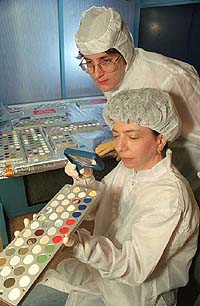
Researchers from NASA's Marshall Space Flight Center in Huntsville, Ala., examine colorful coatings destined for the International Space Station.
Engineered to better withstand the punishing effects of the Sun, extreme temperatures and other elements, the samples will be flown 220 miles above the Earth — outside the Space Station and unprotected by Earth's atmosphere.
By examining how the coatings fare in the harsh environment of space, researchers — including the Marshall Center's Rachel Kamenetzky, holding tray, and Miria Finckenor — seek new insight into making paints and other materials last longer on Earth.
The research is part of the Materials International Space Station Experiment (MISSE) – a project that will test the durability of hundreds of samples ranging from lubricants to solar cell technologies.
Joining other experiments from the public and private sectors, the samples from Marshall will be flown outside the Space Station for one year beginning in July.
The MISSE study is a cooperative effort by the Marshall Center; Air Force Material Command at Wright-Patterson Air Force Base in Ohio; Boeing Phantom Works in Seattle; and other NASA Centers, including Langley Research Center in Hampton, Va., Johnson Space Center in Houston and Glenn Research Center in Ohio.
