
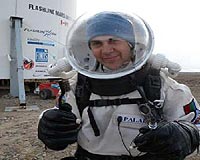
The FMARS Xll 2009 crew has arrived on "Mars" and is now entering their formal simulated Mars mission. They are on Devon Island, north of the Arctic Circle, peering out the portholes of the Mars habitat located at the edge of the Haughton Crater.
The stark beauty of the arctic desert scenery adds to the realism of this epic endeavor, with human explorers restricted by operational constraints similar to those to be faced by future human explorers on Mars. They are living in the habitat, conducting daily EVAs while wearing full analog Mars spacesuits, and limiting their communications with Mission Support and their families back on "Earth."
The six FMARS crew members, from various walks of life and professions, are helping to fulfill the dream of mankind's exploration and settlement of the Red Planet.
The FMARS crew is now beginning their extensive campaign of scientific study that covers a wide range of disciplines and includes many firsts for Mars analog research. These include the first use of a Class IV medical laser during a Mars simulation, helping to relieve crew stress injuries during the mission.
Also employed for the first time in a Mars simulation at FMARS, a UAV (Unmanned Aerial Vehicle) is being used by the space-suited explorers, aiding them in their search for mineral resources. Sites identified by the UAV will then be visited by geologists who will conduct physical geologic sampling, obtaining ground truth.
For the first time, explorers in spacesuits will deploy passive seismic equipment to monitor earthquake activity and characterize the planet's interior. They will also conduct the first geophysical electromagnetic survey as analog Mars pioneers to search for water and characterize geological features under the surface.
The crew also intends to identify and extract hydrated minerals, bringing them back to the habitat to produce drinkable water from these "rocks." A variety of equipment will also be tested, such as geotagging cameras, data-recording GPS units, a tele-presence rover (operated from Florida), as well as MIT-developed mission planning software.
"The crew is excited to get down to work here at FMARS, and to demonstrate how a motivated and passionate group of professionals can conduct groundbreaking research in this one-of-a-kind facility," said Commander Vernon Kramer. "Let the simulation begin!"
Share This Article With Planet Earth
