
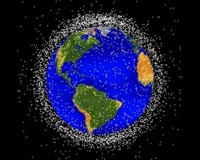
Those familiar with air traffic management architectures understand the constraints of aircraft flying in the atmosphere, vehicle dynamics and command and control techniques. Unfortunately, compared to air traffic, space traffic has many more degrees of freedom and much less control capability. Add to this the completely uncontrolled nature of space debris and the reality that most debris objects cannot be tracked and motion cannot be accurately measured or simulated.
In fact, orbiting debris is a product of negligence.
Over the first 50 years of space flight, mission plans ended with the completion of planned in-space operations. Satellites were shut down and left in their orbits, subject to natural influences.
Little thought was given to any collateral effects of objects "adrift" in space, because "space" was thought of as "big." An analogy might be the ocean disposal of waste items, where junk gets lost in the vastness of the seas, either by sinking to the bottom or by simply drifting with ocean currents.
By contrast, a "drifting" satellite remnant in low orbit is travelling at a speed in excess of 7.3 km/sec (about 16,300 mph). Since orbiting objects can travel in all directions, collisions between satellites and debris can occur at speeds of over 14.6 km/sec (about 32,600 mph).
Of the suspected hundreds-of-thousands of debris objects, only roughly 22,000 are four inches or larger in size and can be tracked. The majority of derelict items remains beyond current tracking capabilities, but are just as dangerous in terms of causing significant damage to operating spacecraft.
Just as weather affects our daily lives, so does Earth's orbiting junkyard. The detrimental effects of space junk grow worse each year, putting our daily lives and national infrastructures increasingly at risk as our communications, science and security networks rely ever more heavily on the interconnected system of satellites orbiting the skies.
One area of current interest to the regulatory community is space traffic management. This is a topic of particular concern for several agencies including NASA, ESA, DOD and FAA. Within the U.S., NASA is responsible for human space flight and scientific exploration. FAA is responsible for commercial space traffic. DOD is responsible for military and intelligence space traffic. Unfortunately, "space" is not like "airspace."
Space has no boundaries or borders. Satellites cannot avoid sovereign borders, while aircraft can be constrained to operation over specified territories. An all-inclusive space traffic management system, if developed, may have to deal a multitude of yet-to-be-determined constraints, regulatory philosophies and political challenges. Overlay onto this the presence of orbital debris and space traffic management approaches get even more complex.
While we understand weather and have learned techniques to deal with it, the impact and disposition of orbital debris are not fully understood. Unlike weather, space junk is man-made and will significantly hinder the nation's future economy and security.
It is a growing threat to space-based communications, weather forecasting, banking processes, scientific exploration, Earth observation and future space tourism. Space commerce is growing, and as this industry expands the need for an effective traffic management system will become critical to continued commercial growth and future exploitation of space.
At the moment, there are no programs in place to deal with orbital debris, even though new satellites continue to be launched at a rate of over 100 each year.
Most of these launches will contribute to the already-large orbital debris population. With over 60 countries operating in space, the exponentially growing problem of orbital debris will take international collaborations and partnerships to conceive and develop innovative solutions and strategies as part of an international space traffic management architecture.
