
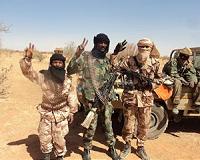
Mali's former rebel alliance on Tuesday rejected a national reconciliation charter unveiled on the second anniversary of the signing a peace deal with the government, underscoring the country's fraying peace process.
Ex-rebels of the Coordination of Movements of Azawad (CMA) signed a peace deal on June 20, 2015 aimed at curbing separatist uprisings in Mali's north after a 2012 rebellion was hijacked by jihadists, throwing the nation into chaos.
A ceremony to hand the president the national reconciliation charter written by a committee of experts was boycotted by the CMA, which said none of its recommendations made in early April at a peace conference were taken into account.
The absence of its suggestions, it said, "consequently means there is no chance of reaching agreement, and even less for bringing peace and national reconciliation," according to a statement seen by AFP.
The charter and peace conference were supposed to advance a peace process which among other provisions aims to integrate one-time rebel commanders into positions of authority in the north, and operate "mixed patrols" of former rebel groups with the regular army.
Mali's mediator at the peace conference, Baba Hakib Haidara, maintained the document was "guided… by the conclusions of the national reconciliation conference, recognising the deep-rooted causes of the crises that have marked our country since independence," speaking at Tuesday's ceremony.
Mali's jihadists did not sign the peace deal and have continued to wreak havoc despite an ongoing French-led military intervention in 2013 to remove them.
In a sign of their growing confidence, an Al-Qaeda-linked jihadist alliance claimed responsibility Monday for an attack on a tourist resort near Mali's capital that left five people dead.
The head of the political opposition Soumaila Cisse said it had not been involved in the design of the document and could not comment on its contents, and the document has yet to be made public.
France, US agree UN draft on anti-jihadist Sahel force
United Nations, United States (AFP) June 20, 2017 –
France and the United States have reached agreement on a draft UN resolution that would pave the way for the deployment of a five-nation African military force to fight jihadists in the Sahel region, diplomats said Tuesday.
A vote at the UN Security Council could take place as early as Wednesday on the draft resolution that welcomes the deployment but does not give it full UN authorization, according to the agreed text seen by AFP.
Burkina Faso, Chad, Mali, Mauritania and Niger — which make up the G5 — agreed in March to set up a special counter-terrorism operation of 5,000 troops for the Sahel region.
France had requested that the Security Council authorize the force in a first draft text circulated two weeks ago that would have given the G5 troops a UN mandate to "use all necessary means" to combat terrorism, drug trafficking and people smuggling.
The United States however had opposed UN authorization for the force, arguing that it was not legally necessary and that the mandate was too broad and lacking in precision.
The new draft resolution "welcomes the deployment" of the G5 force "with a view to restoring peace and security in the Sahel region" and drops a provision that invoked chapter 7 of the UN charter, which authorizes the use of force.
The United States had argued that a simple statement welcoming the regional force would have been sufficient, but France insisted that a full resolution was needed in line with a request from the African Union.
France carried out a military intervention in Mali in 2013 to drive out jihadist groups, some of which were linked to Al-Qaeda, which had seized key cities in the country's north.
Although the Islamists have been largely ousted from the north, jihadist groups continue to mount attacks on civilians and UN forces in violence that has engulfed parts of central Mali.
C. Africa govt inks peace deal with rebel groups
The Central African Republic's government on Monday signed an "immediate ceasefire" deal with rebel groups at a meeting in Rome aimed at ending violence in the strife-torn country.
The accord, negotiated over five days, was hailed as a precious chance to stabilise one of the world's most volatile and poorest countries.
Under it, armed groups will be given representation in the political … read more
