
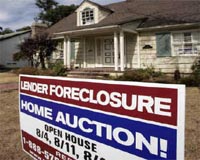
A year has passed since the credit crunch first jolted financial markets, but there still appears to be little light at the end of the tunnel despite emergency measures taken by the US authorities.
What started out as a collapse in the US housing market, worsened last year as increasing numbers of subprime, or high-risk, mortgage holders defaulted on their loans, contaminating the wider financial system in a domino-like run that has yet to end.
Some commentators have compared the housing and financial woes to the Great Depression, especially as the US economy has flirted with recession and as hopes of a stock market revival have so far fallen flat.
The turmoil has been particularly acute on Wall Street, where the benchmark Dow Jones Industrial Average has slumped 13 percent since August of last year leaving investors with heavy losses.
"Since last summer the same pattern has occurred at least six times: lousy economic and financial news that lead to an equity market fall; then surprise action by the Fed or the government to stimulate and rescue markets," Nouriel Roubini, an independent economist, said in a briefing note.
He said government action so far has tended to boost markets for a brief period, but that each time the "tsunami" of bad economic news has soon hammered sentiment back down.
Roubini has been bearish about market prospects, but his views have gained currency as the markets have remained stuck in a funk of late.
"Clearly the financial markets and the economy have entered a new danger zone, with increased risk of a major negative event and a hard landing for the economy," said Brian Bethune, chief US financial economist at Global Insight.
The banking industry has been hit particularly hard and worries about a large failure have been stoked anew since the collapse of California-based IndyMac bank last month.
The credit vacuum has become more pronounced in the past year as banks have become more wary about lending cash to each other, gumming up the US and global financial system even more.
The International Monetary Fund — the guardian of the global financial system — warned last month of a possible "negative feedback loop between the financial system and the broader economy."
The IMF also underlined that while subprime-related losses appear to have been largely realized, other types of credit are exhibiting strains.
And the stressed housing market is not out of the woods yet.
The rate of US home foreclosures jumped 121 percent in the year to the second quarter while home prices have dived a hefty 15.8 percent in the year to May in 20 large metropolitan areas.
The White House, the Federal Reserve and the Treasury have all sought to soothe the credit angst, but their respective interventions have yet to put a halt to the liquidity crunch.
The administration of President George W. Bush approved an emergency 168-billion-dollar economic stimulus this year to boost the economy. The stimulus was stuffed with one-off tax rebates aimed in part at boosting consumer spending and offsetting spiking gasoline prices.
And the Fed slashed its main interest rate by 3.25 percentage points between September and April to help the economy while extending lending facilities never before offered to banks.
Despite such gambits to keep the system afloat, credit conditions remain fragile and 30-year mortgage rates are near their highest level in a year.
The credit upset has also triggered a debate about the US regulatory system, much of which traces its roots to the 1930s, and appeals for reform.
It is clear that there will be plenty of time for further reflection as economists do not expect to see much light at the end of the tunnel for some time.
"My call earlier this year 'fine in 2009' is looking premature. For now, we can only hope for better times again in 2010," said John Makin, an economist and former Treasury consultant, at the American Enterprise Institute.
