
The Expedition 20 crew members had a light-duty work day and performed a variety of maintenance and science-related tasks Monday as they prepare for a busy week aboard the International Space Station.
Flight Engineer Frank De Winne installed cables to prepare for the set up of the new Combined Operational Load Bearing External Resistance Treadmill (COLBERT) that arrived aboard space shuttle Discovery during STS-128.
The crew members unpacked many of the COLBERT treadmill's components and started the lengthy assembly process. They will be occupied with the assembly and outfitting of the treadmill in the Harmony node throughout the week.
The Canadian-built Special Purpose Dexterous Manipulator (DEXTRE) had its first significant workout today. It will be commanded to perform various manipulative tasks over the next three days in advance of maintenance work on a remote power control module component scheduled for next year.
Commander Gennady Padalka and Flight Engineer Michael Barratt reviewed Soyuz descent procedures as they move into the final two weeks of their half year aboard the station. They are scheduled to leave in the Soyuz TMA-14 spacecraft the night of Oct. 10 and land in Kazakhstan early the next day.
Meanwhile, the Expedition 21 crew, Flight Engineers Maxim Suraev and Jeffrey Williams, and spaceflight participant Guy Laliberte prepared for Wednesday's 3:14 a.m. EDT launch to the station from the Baikonur Cosmodrome in Kazakhstan. They are scheduled to arrive and dock to the station on Friday.
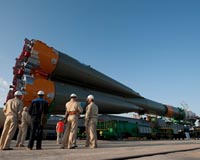
The Soyuz TMA-16 spacecraft was transported from its assembly building at the Baikonur Cosmodrome on Monday to the Site 254 launch pad and rotated from its horizontal position on its railcar to its vertical position on the pad.
The ISS Progress 34 cargo craft, filled with trash, was deorbited Sunday at 5:33 a.m. and burned up in the Earth's atmosphere over the Pacific. It undocked automatically from the station last week.
related report
NASA Publishes Report about International Space Station Science
Advances in the fight against food poisoning, new methods for delivering medicine to cancer cells, and better materials for future spacecraft are among the results published in a NASA report detailing scientific research accomplishments made aboard the International Space Station during its first eight years. The report includes more than 100 science experiments ranging from bone studies to materials research.
Share This Article With Planet Earth
