
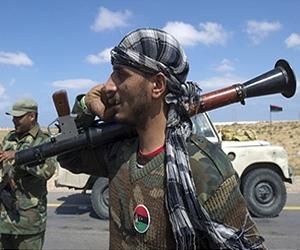
Libyan rebels fired off barrages of rockets from west of the front line town of Ajdabiya Friday as NATO warplanes few high above, an AFP reporter said.
A Libyan rebel convoy fitted with big guns and rocket launchers had earlier driven westwards past Ajdabiya, a key crossroads town in east Libya in rebel hands, to see if pro-regime forces had been rolled back by NATO warplanes.
The rebel convoy of pick-up trucks had nosed cautiously west, past a point that late Thursday was the scene of a brief exchange of rocket and mortar fire with troops loyal to Kadhafi.
They soon afterwards sent off volleys of rockets but received no return fire, leaving the whereabouts of Moamer Kadhafi's forces unknown.
NATO warplanes were heard flying high above and sound of explosions could be heard in the distance but it was unclear whether they were bombings.
Journalists were prevented by a rebel checkpoint on Ajdabiya's outskirts from following the convoy.
The insurgents, fearful that live media coverage might give away their position and firepower to their enemy, shooed reporters away as they massed in Ajdabiya early Friday.
It was an unusual burst of activity on what is usually a slow-moving prayer day in the Muslim world.
On Thursday, NATO jets were heard, but not seen, flying above the front line.
A couple of big explosions were heard in the distance which might have been air strikes.
The planes' intensified presence came as NATO foreign ministers agreed to keep up military pressure against Kadhafi's forces.
earlier related report
Britain's fighter jets 'grounded by spares shortages'
London (AFP) April 15, 2011 –
Britain's Eurofighter Typhoon jets, which carried out their first Libya bombing missions this week, were grounded last year due to shortages of spare parts, lawmakers said Friday.
The parliamentary report said five Typhoon pilots had to be grounded temporarily because there were insufficient fully operational aircraft for them to log the required flying time.
It noted that the shortages had also affected pilots' training last year, with only eight of the Royal Air Force's 48 Typhoon pilots qualified for ground attack operations — the role the plane is currently being used for in Libya.
The bombing of two tanks near the city of Misrata this week was the first time the Typhoon has fired its weapons in anger in a ground attack role since entering service with the RAF.
Defence Secretary Liam Fox insisted on Thursday that the Eurofighter project was "finally under control and on track".
But the RAF is currently having to 'cannibalise' aircraft for spare parts in a bid to keep the maximum number of Typhoons operational on any given day.
The Commons Public Accounts Committee scrutiny body said the Ministry of Defence had warned the problems were likely to continue until 2015 when it expects the supply of spares finally to have reached a "steady state".
"The department (MoD) relies on a small group of key industrial suppliers who have the technical and design capability to build, upgrade and support Typhoon," the committee said.
"Problems with the availability of spare parts have meant that Typhoons are not flying as many hours as the department requires."
It said the supply chain for Typhoon spares was "complex and stretches across Europe".
However, the department admitted that the supplies process "had not been managed well enough or delivered all the required parts when needed."
The cost of the Typhoon project has soared since its inception due to bad planning and over-optimistic targets, Britain's public sector spending watchdog said last month.
Share This Article With Planet Earth
