
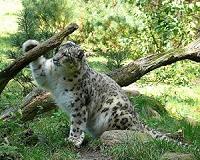
Leopards, jackals and other creatures living in Islamabad's tree-covered hills have been enjoying a rare respite from the throngs of hikers and joggers that normally pack the trails.
Rangers in the Pakistani capital's Margalla Hills National Park saw animal activity increase soon after the city was locked down in March to counter the coronavirus.
Islamabad's normally reclusive leopards have been roaming onto deserted pathways, and social networks are rife with talk of purported sightings.
Motion-triggered wildlife cameras have been clicking away as animals explore areas they had long been nervous to visit.
"There is a big increase in the number of animals (seen) in the national park," ranger Imran Khan — not to be confused with the namesake prime minister — told AFP.
Images the park provided to AFP include pictures of leopards padding along paths, an inquisitive jackal and a muddy boar.
"Wildlife is comfortable as there are no visitors here. They are wandering here comfortably, which is a good sign for the jungle," Khan said.
The park was locked down for about a month and foot traffic remains light as families, picnickers and walkers stay away during the fasting period of Ramadan.
Sakhwat Ali, Islamabad's assistant wildlife director, said the space is home to 38 mammal species, 350 bird species and 34 reptile species including 27 types of snake.
Ali added that rangers are conducting a survey and had already noticed new creatures.
"There are some species of butterfly which were not reported earlier, but these are visible now," Ali said.
Lockdowns in various cities around the world have seen urban wildlife grow bolder as people stay home. A gang of goats was spotted in a Welsh town and coyotes were seen exploring deserted streets in San Francisco.
Scientists name four new Elvis worm species
Washington DC (UPI) May 15, 2020 –
The group of deep sea worms known as Elvis worms is comprised of at least four distinct species, according to a new study.
The new species were collected by scientists over the course of several years. The four species are technically scale worms, but researchers began referring to them as Elvis worms — a reference to their unique appearance. The deep sea scale worms sport iridescent plate-covered shells that recall the King's sequined jumpsuits.
Scientists were only recently able to distinguish between different Elvis worm species by using genetic analysis. Researchers described the four species — Peinaleopolynoe goffrediae, P. mineoi, P. orphanage and P. elvisi — in a new paper published this week in the journal ZooKeys.
Beneath their glittering scales are lung-like branching structures. Researchers suspect the organ evolved its complexity to help the worms breathe in low-oxygen environs. Most of the Elvis worms were found near whale carcasses and other kinds of decaying organic matter. One of the newly named species was found living near a hydrothermal vent.
All four of the newly named species were found at least 3,280 feet below the surface of the ocean, too deep for sunlight to reach.
While some deep sea creatures feature eyes, the Elvis worms do without. The worms don't produce light themselves, and they can't see light without eyes, so their iridescence serves no communicative purposes.
Instead, scientists suspect the glitter of their scales offer some kinds of defensive benefit. Deep-sea predators with flashlights under their eyes might receive a blinding glare when honing in on an Elvis worm. It's also possible their iridescence serves no functional purpose at all.
Researchers also noticed what they thought were notches on their shells. After capturing video of a pair of worms tussling, scientists realized they weren't looking at notches.
"It wasn't until we saw that video of them fighting that it suddenly clicked. Like, 'Wait — these things in the scales, these notches, are bite marks,'" Greg Rouse, a marine biologist at the Scripps Institution of Oceanography at the University of California, San Diego, told Inside Science.
