
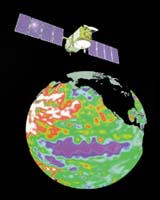
Jason-1 completes its 5th year on orbit on 7 December 2006. From its vantage point 1,330 kilometers (860 miles) above Earth, this follow-on to the highly successful TOPEX/Poseidon mission has provided measurements of the surface height of the world's oceans to an accuracy of 3.3 centimeters (1.3 inches).
With this milestone, Jason-1 surpasses both its primary and extended mission phases and continues to collect valuable ocean data for researchers and operational users worldwide.
A joint program of NASA and the Centre National d'Etudes Spatiales (CNES) in France, Jason-1 has vastly improved our understanding ocean circulation and its effect on global climate.
The primary objectives of Jason-1 include;
– Extending the ocean-surface topography time measurements begun by Topex/Poseidon into the 21st century
– Increasing our understanding of ocean circulation
– Improving climate forecasting
– Measuring global sea-level change
– Improving coastal tide models
Some of the important ongoing science investigations for Jason-1 include;
– Studying ocean variability on decadal scales and its relations to climate
– Understanding how changes in the ocean's heat content and mass affect global sea level
Producing better tide models for the coastal oceans where the scales of tides are too small to be resolved by a single altimeter.
Studying ocean eddies and their effects on large-scale ocean circulation and heat transport.
Assimilating altimetry data with wind, temperature, and salinity data for improved prediction of El Nino-related climate events.
TOPEX/Poseidon enabled scientists to forecast the impact of the 1997-1998 El Nino. Jason-1 has viewed several less dramatic climate events in the Pacific Ocean, including the current mild El Nino and slow changes in the Pacific Decadal Oscillation.
The next-generation NASA ocean altimetry mission, which will be the follow-on to Jason-1, is the Ocean Surface Topography Mission (OSTM) on Jason-2. This joint mission, with partners CNES, Eumetsat, and NOAA, will extend the ocean-surface topography time series even further, and is scheduled to launch in 2008.
