
Japanese authorities said Monday they would begin planning restoration work to reinforce two famous castles due to fears they could collapse in one of the country's frequent earthquakes.
Nijo Castle, a UN World Heritage site in the heart of the ancient capital Kyoto, will undergo a series of tests this summer paid for by the city government, castle spokesman Kazuo Sakamoto said.
The 20-million-yen (170,000-dollar) study will assess the condition of two wooden palaces inside the 17th-century complex, which sprawls across 275,000 square meters (330,000 square yards).
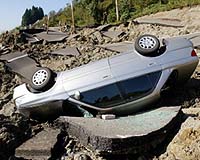
One of the buildings, Hommaru Palace, was tilted in 1995 when a massive earthquake devastated Kobe, located 50 kilometers (30 miles) south of Kyoto, killing 6,433 people in Japan's worst postwar disaster.
Nijo Castle is also stepping up efforts to restore 900 mural paintings that are losing their luster, Sakamoto said.
The renewed effort to protect historic sites comes amid a nationwide scare over earthquake protection after a cost-cutting architect admitted he conspired to falsify quake-resistance data for some 100 new buildings across Japan.
Researchers also reported that Himeji Castle, one of Japan's best-preserved castles, could collapse in a strong earthquake.
The six-floor main building of Himeji Castle, where "The Last Samurai" starring Tom Cruise was filmed, could tumble from the third story up, the Architectural Research Association found, according to Kyodo News.
The western city of Himeji is planning to begin reinforcement work on the castle, which was not damaged by the 1995 earthquake in nearby Kobe, from the 2009 fiscal year.
Source: Agence France-Presse
