
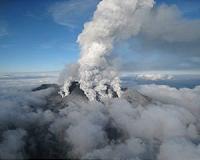
Japanese search teams returned to the peak of a volcano Wednesday for the first time in eight months to look for the bodies of six climbers still missing after an eruption that killed dozens.
Around 50 people, including police, firefighters and volcanologists, began an exploratory ascent of Mount Ontake in central Nagano prefecture with a view to resuming a full-scale search next month, after the rainy season.
The 3,067 metre (10,121 feet) Mount Ontake was packed with hikers out to see the region's spectacular autumn colours when it burst unexpectedly to life on September 27 last year.
The shock eruption was Japan's deadliest for almost 90 years, leaving an estimated 63 people dead, many of their bodies at least partially entombed in volcanic sludge.
Dramatic mobile phone footage showed hails of rock raining down as clouds of ash and smoke engulfed walkers on the volcano, which has long been popular among casual hikers.
Search and rescue teams trudged through thick, clay-like ash to recover 57 bodies in sometimes treacherous conditions, despite fears over toxic fumes and further eruptions.
The operation was suspended in October as autumn's rains began to give way to snow, which soon made the peak impassable.
"There is a part of me that feels rather worried about what it is like up there" around the summit, Noriyuki Hayashi, senior officer at Nagano prefecture police, told journalists Wednesday as the team prepared ascend Mount Ontake.
"But we will do what we can."
The team observed a moment of silence in front of the mountain, which — even in the summer months of June — still has snow-covered ravines.
Aerial footage showed the searchers' bright outerwear against the grey lunar landscape of the ash-covered peak.
Ontake is one of scores of active volcanoes in Japan, which sits on the so-called "Ring of Fire", where a large proportion of the world's quakes and eruptions are recorded.
Last month, authorities evacuated a small island off Japan's far south coast when the volcano there erupted.
Autopsies on bodies recovered from Ontake last year revealed many of them died from injuries caused by flying rocks.
That led to a recommendation in March that people who climb Mount Fuji — also a volcano — should carry helmets and goggles with them.
Last two missing in Malaysian quake confirmed dead
Kuala Lumpur (AFP) June 10, 2015 –
The death toll following a strong earthquake that jolted Malaysia's Mount Kinabalu last week has risen to 18 after the final two remaining victims who were unaccounted for were confirmed dead on Wednesday.
The remains of Navdeep Singh Jaryal, a Singaporean student and Mohammad Ghazi Mohamed, a Singaporean teacher, will be sent to their home country after further forensic tests in Malaysia, according to a statement from Singapore's education ministry.
As a result, Malaysian authorities said they would end their search and rescue operations.
"These are the final two people who were missing. We will stand down the search and rescue by the end of today," said Mohammad Farhan Lee Abdullah, police chief of the town of Ranau near the mountain.
Singapore declared a day of national remembrance on Monday after it lost a group of students and teachers in the earthquake.
Of the 18 who died, seven students and three adults were from Singapore.
The students were taking a route to the summit known as the Via ferrata — Italian for "iron road" — which was one of the worst-hit areas, traversing a steeply sloping granite rock face.
They were among 29 students and eight teachers from Singapore's Tanjong Katong Primary School who were part of an excursion to the popular climbing destination.
A minute's silence was observed on Monday at all Southeast Asian Games venues at the start of the competition, which Singapore is hosting.
The 6.0-magnitude quake struck early Friday near the picturesque mountain, triggering thunderous landslides that obliterated sections of trail on the peak in the Malaysian state of Sabah on Borneo island.
