
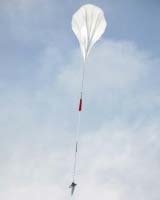
Italy has successfully tested a prototype of an unmanned space shuttle, dropping the vehicle from high altitude to see how it copes with the stress of re-entry, the Italian Centre for Aerospace Research (CIRA) said on Thursday.
"The launch took place successfully at 0730 GMT on February 24 from Tortoli airport in Sardinia, and the mission was concluded at 0930 GMT with the splashdown of the USV (unmanned space vehicle) in an isolated maritime zone," CIRA said in a statement posted on its website Thursday.
Named Castore, the prototype is a white, torpedo-shaped craft 9.2 metres (30 feet) long and 3.7 meters wide and weighs 1.25 tonnes. It was hoisted by balloon for two hours, to an altitude of 31,000 metres.
Castore was then released from a lower height of 21,000 metres.
It reached a speed of Mach 1.05 in 70 seconds, by which time it had fallen to an altitude of between 16,000 and 10,000 metres. A three-stage parachute system then let the USV spash down safely for recovery.
The mission's goal "was to simulate the final part of a space vehicle's re-entry into the atmosphere," CIRA said, adding that more than 500 sensors transmitted data during the drop.
"The USV program, and in particular the first two aircraft built, Castore (Castor) and Polluce (Pollux), which currently alternate flights, are the only example in the world of operational space demonstrators currently in use," CIRA said.
The programme began in 2002 and is set to continue until 2012, at a cost of 179 million euros (235 million dollars).
The European Space Agency, the Italian Space Agency (ASI), the National Research Council (CNR) and the Italian air force and navy collaborated in the effort.
Source: Agence France-Presse
