
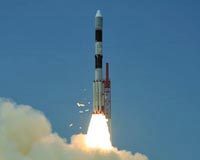
The Indian space agency is strongly suspecting the failure of pyro elements for the non-separation of the heat shield of its rocket Polar Satellite Launch Vehicle's (PSLV) XL variant on Aug 31, said a senior official.
As a result of the heat shield not separating the 1,425 kg navigation satellite IRNSS-1H got stuck inside it resulting in the failure of the around Rs 250 crore mission.
Normally the heat shield will be separated soon after the rocket crosses the earth's atmosphere.
According to K. Sivan, Director, Vikram Sarabhai Space Centre (VSSC), all the systems during the rocket's flight worked well while the only suspect place is the pyro elements.
The VSSC is part of the Indian Space Research Organisation (ISRO).
"Tests are going on to find out the reasons for the failure of heat shield separation. Each test takes around 72 hours," Sivan told IANS.
One fortunate aspect of the failure is that ISRO has all the flight data as the rocket was not lost during its one way journey.
Sivan said the heat shield would separate after on-board computers give the command to ignite the explosives. The explosives would then ignite and explode to separate the two parts of the heat shield joined by bolts.
Pentagon Will Have to Rely on Russian Rocket Engines Until Mid-2020s
The US Defense Department's technical and funding challenges will result in Pentagon using the Russian RD-180 rocket engines until mid-2020s which is longer than it had initially been expected, local media reported on Monday.
The US Wall Street Journal newspaper reported that the US Air Force and Pentagon leadership initially said that the replacement of the Russian engines with the US dom … read more
