
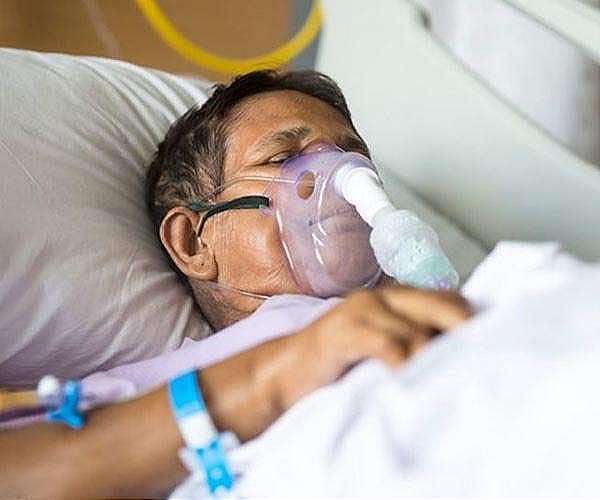
Israel on Sunday opened a new coronavirus treatment facility co-run by the army's medical corps, an unprecedented move for the military unit, aimed at bolstering an embattled healthcare system.
The Jewish state currently has one of the world's highest daily coronavirus infection rates per capita, with the number of seriously ill patients steadily rising.
The army-backed unit at the Rambam Hospital in the northern city of Haifa includes a control room where patients are monitored via video and an underground coronavirus ward that used to be a car park.
Avi Weissman, deputy manager at the hospital, said the army's intervention would allow Rambam to restore services cut due to the increasing coronavirus workload.
"We had to close down operating rooms, we had to close down some regular ambulatory services (and) we had to close down elective surgery," Weissman told AFP.
He said that with the help of the army "we will be able to free up Rambam personnel (to go back) to regular floors".
Israel's army medical corps typically treats Israeli military personnel and deploys to foreign humanitarian crises.
The pandemic marks the first time the unit has worked inside a civilian hospital, said Ariel Furer, head of the army's COVID-19 department.
"We understand that the times are very difficult. The pandemic is here to stay," he told AFP.
The new coronavirus ward was initially build as an underground medical facility before being converted to a car park, which has been reconverted to receive patients as COVID-19 cases surge.
It currently has roughly 60 patients but could accomodate up to 800 if the epidemic in Israel continues to escalate, Weissman said.
One coronavirus patient, 56-year-old Felix Winitsky, told AFP that his whole family had contracted COVID-19 and that his father died from the virus 10 days ago.
"Until now I thought that corona was not a big deal," he said. "But when it touches you, it's a very difficult disease."
Israeli Defence Minister Benny Gantz, at Rambam for the unit's opening, said the army "was working on closing the gaps that have formed within a good public healthcare system that has been neglected for a decade."
That criticism of Gantz's former election rival Prime Minister Benjamin Netanyahu echoes comments from independent experts who accuse the premier of not prioritising healthcare since taking office in 2009.
Israel, a country of about nine million people, has recorded more than 290,000 coronavirus cases, including 1,956 deaths.
Hong Kong scientists say anti-microbe drug successful against coronavirus
Hong Kong (AFP) Oct 12, 2020 –
An affordable anti-microbial drug used to treat stomach ulcers and bacterial infections has shown promise in combatting the coronavirus in animals, scientists in Hong Kong announced Monday.
Researchers set out to explore whether metallodrugs — compounds containing metal that are more commonly used against bacteria — might also have anti-viral properties that could fight the SARS-CoV-2 coronavirus.
Using Syrian hamsters as tests subjects, they found that one of the drugs, ranitidine bismuth citrate (RBC), was "a potent anti-SARS-CoV-2 agent".
"RBC is able to lower the viral load in the lung of the infected hamster by tenfold," Hong Kong University researcher Runming Wang told reporters on Monday as the team presented their study.
"Our findings demonstrate that RBC is a potential anti-viral agent for Covid-19."
The coronavirus has killed more than a million people since it first emerged in China last December and then spread across the globe.
As scientists scramble to find a vaccine, they have also been scouring readily available drugs that might alleviate symptoms caused by the Covid-19 disease or help the body fight infection.
Remdesivir, a broad-spectrum antiviral drug, and dexamethasone, a type of corticosteroid, have both been identified as having some success against the virus. Both were used by doctors to treat US President Donald Trump after he contracted Covid-19.
But they have drawbacks.
Remdesivir is expensive and there is a global shortage while dexamethasone has immunosuppression effects that are risky for all but the most ill patients. Other drug cocktails have shown liver damage can be a risk.
The Hong Kong scientists said RBC was a commonly available drug used against stomach ulcers with a safe and comprehensive pharmacological profile.
"It's been used for decades so it's pretty safe," Wang said.
They added that their research, which has been published in the journal Nature Microbiology, suggested other metallodrugs might also have success against the virus and should be further explored.
