
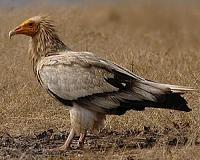
Israeli police said Monday they have arrested a man suspected of poisoning nearly half the already-threatened vulture population in the Israeli-annexed Golan Heights.
A resident of the Bedouin village of Tuba Zangariya in northern Israel was detained on Sunday and remanded in custody by a court in Tiberias, police said in a statement.
Police did not mention any apparent motive, but posted a picture of a cow carcass the suspect had allegedly dosed with poison.
Local media said such poisonings in the past had been caused by farmers putting out poisoned bait to stop predators attacking their herds.
Eight out of around 20 griffon vultures left in the Golan were found dead Friday, Israel's Nature and Parks Authority head told AFP, in what he described as "a mortal blow to the birds of prey population".
A fox and two jackals were also found dead and two sick vultures were taken to a wildlife clinic for treatment, the organisation's director Shaul Goldstein said.
The vulture population on the Israeli side of the Golan Heights has declined significantly over the past two decades, with their number dropping from 130 in 1998 to around 20 before the latest deaths.
In 2016, UN peacekeepers helped return a vulture which had been captured across the border in Lebanon on suspicion of being used for spying for the Jewish state.
Israel seized around 1,200 square kilometres (460 sq miles) of the Golan from Syria in a 1967 and later annexed it, in moves never recognised by the international community.
About 18,000 Syrians belonging to the Druze community — most of whom refuse Israeli citizenship — remain in the occupied Golan, alongside some 20,000 Israeli settlers in 33 communities.
Catapulting spider winds up web to launch itself at prey: study
Washington (AFP) May 13, 2019 –
Just when you thought spiders couldn't get any more terrifying.
A study published Monday has found that an arachnid species is capable of winding up its web to store up elastic energy, before releasing its grip and catapulting itself at furious speed toward its unsuspecting prey.
The development places the triangle-weaver spider, or Hyptiotes cavatus, alongside humans as the other known species to amplify muscular energy with external devices, a feat people achieve with crossbows or ballistae.
Researcher Sarah Han, a doctoral student at the University of Akron in Ohio, said she had been intrigued by the spider during her walks in the woods.
"It did this interesting mechanism while hunting we didn't really know that much about," she told AFP. "People had written about it in an observational way, but no one had quantified it."
Han and colleagues observed the spiders under lab conditions, recording high-speed videos of them as they hunted flies.
"The spider uses its muscles to wind back the web — like you use your arms to hold a bow string — then holds it in that position till a prey comes into contact with the web," she said — maintaining tension on its anchor line for hours on end.
"When the spider releases the web, both spider and web accelerate forward very rapidly.
"The rapidly moving web tangles around the prey insect, starting the capture process from a distance."
The team's paper, published in the Proceedings of the National Academy of Sciences (PNAS), found that the spiders launched themselves forward at accelerations of up to 772.85 meters per second squared — or the equivalent of 400 body lengths in a second.
They confirmed that the action was a result of latent energy stored in the silk being released, as opposed to just jumping using the power of its legs, by calculating the total power generated and finding it vastly exceeded the potential output of its muscle mass alone.
The spider also maintained a fixed body posture after releasing its hind tarsal claw.
According to the study, using a constructed device as a weapon offered numerous advantages, freeing the spider from the need to evolve specialized anatomy to generate and store energy.
It also allowed Hyptiotes to attack their prey from afar, reducing the potential for taking damage — advantages that also led humans to develop power-amplifying weapons.
According to Han, there could be more species of spiders using stored energy in silk to capture prey, an area for potential further study.
Moreover, the team were unable to determine the spider's "catch mechanism" for holding on to the web, which could yield practical applications for humans down the line.
"It's valuable in understanding how it can hold such a large amount of energy compared to its body size," said Han. "Maybe it's come up with something novel that we can use."
