
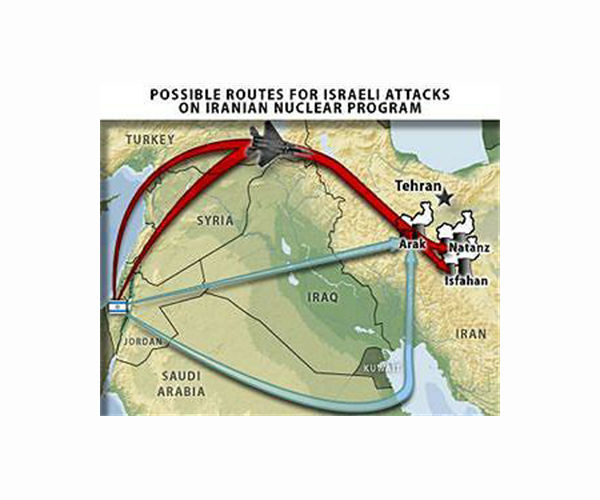
Israeli Prime Minister Yair Lapid arrived in Germany on Sunday in his latest diplomatic effort to persuade Western powers to ditch their tattered nuclear deal with the Jewish state's arch nemesis Iran.
Israel has long opposed a revival of the 2015 accord, which has been moribund since then US president Donald Trump unilaterally withdrew in 2018 and reimposed biting sanctions on Tehran.
Momentum that built towards a restored agreement last month appears to have slowed, after the three European nations party to the agreement — Germany, France and Britain — on Saturday raised "serious doubts" about Iran's sincerity in restoring the deal.
Meeting his cabinet before flying to Berlin, Lapid thanked the three countries for the "strong position" they had voiced in a tripartite statement on Saturday.
The European nations charged that Tehran "has chosen not to seize this critical diplomatic opportunity", adding that "instead, Iran continues to escalate its nuclear programme way beyond any plausible civilian justification". Iran's foreign ministry criticised those comments as "unconstructive."
Lapid told his cabinet that "Israel is conducting a successful diplomatic campaign to stop the nuclear agreement and prevent the lifting of sanctions on Iran.
"It is not over yet," he added. "There is still a long way to go, but there are encouraging signs."
A senior Israeli official told AFP: "Our understanding is that there will be no return to the JCPOA at least until mid-November. We are working with our partners to develop a new strategy."
The official added: "It's important to continue to coordinate positions and to influence the European position. Germany has an important role in this".
Lapid is scheduled to meet Chancellor Olaf Scholz, Foreign Minister Annalena Baerbock and President Frank-Walter Steinmeier before returning to Israel late Monday.
The 2015 agreement, known formally as the Joint Comprehensive Plan of Action (JCPOA) , gave Iran sanctions relief in return for restricting its nuclear programme.
Negotiations underway in Vienna since April 2021 have sought to restore the agreement, by lifting the sanctions on Tehran and pushing Iran to fully honour its prior nuclear commitments.
Israel insists Iran would use revenue from sanctions relief to bolster allied groups capable of attacking Israelis, notably Lebanese Shiite group Hezbollah, and Hamas and Islamic Jihad, two key Palestinian militant organisations.
Last month, the European Union, which acts as the mediator of the nuclear talks, put forward a "final" draft of the agreement.
Iran and the US then took turns to respond to the text, with Washington saying on Friday that Tehran's reply was a step "backwards".
Lapid, whose late father survived the Holocaust, is also travelling with a delegation of survivors who will join him and Scholz on a visit to Wannsee, site of a 1942 conference where top Nazi officials finalised plans to send Jews to death camps.
Iran says 'ready to cooperate' with UN nuclear watchdog
Tehran (AFP) Sept 12, 2022 –
Iran reaffirmed Monday its "readiness" to cooperate with the UN nuclear watchdog, after the agency said in a report it "cannot assure" the peaceful nature of Tehran's nuclear programme.
The finding last week by the International Atomic Energy Agency (IAEA) further complicated diplomatic efforts to revive a landmark 2015 nuclear deal between Iran and major powers, including the United States.
Iran is "ready to cooperate with the agency to clear up the false and unrealistic perceptions regarding its peaceful nuclear activities", foreign ministry spokesman Nasser Kanani said in a press conference.
Tehran declares its "readiness to continue constructive cooperation with the IAEA", Kanani added, also pointing to the agency's "obligations".
In its report last Wednesday, the IAEA said it was "not in a position to provide assurance that Iran's nuclear programme is exclusively peaceful".
The IAEA has been pressing Iran for answers on the previous presence of traces of nuclear material at three undeclared sites. The issue led to a resolution criticising Iran being passed at the June meeting of the IAEA's board of governors.
Tehran, which has consistently denied seeking nuclear weapons, responded to the resolution by disconnecting 27 cameras allowing the agency to monitor some of its nuclear activities.
The IAEA board met again in Vienna on Monday for its quarterly meeting.
"To our knowledge, no draft resolution has been submitted for this meeting," Kanani said.
Any further "unconstructive action" by the agency, Kanani said, "will again have unconstructive results".
Tehran has demanded that the IAEA's probe be concluded as part of any deal — one of the sticking points in the talks to restore the 2015 agreement that gave Iran much-needed relief from sanctions in return for curbs on its nuclear programme.
The United States unilaterally withdrew from the deal in 2018 under then-president Donald Trump, reimposing biting economic sanctions that prompted Iran to begin rolling back on its own commitments.
Last month, the European Union put forward a "final" draft of the agreement to lift sanctions on Tehran once again and push Iran to fully comply with its obligations.
