
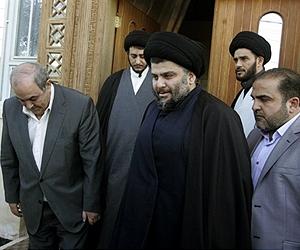
Iraq's radical anti-US Shiite cleric Moqtada al-Sadr has expressed support for Syrian President Bashar al-Assad, even as much of the Arab world turns against the embattled strongman.
Assad has since March been trying to crush a popular uprising against his government, in which over 3,500 people have been killed, according to UN figures.
The Arab League on November 12 voted to suspend Syria, although Iraq itself abstained, and Arab leaders on Wednesday gave Assad three days to halt his "bloody repression" of protests or face sanctions.
But there is "a big difference" between what is happening in Syria and the "great revolutions in Tunisia, Egypt, Libya, Bahrain and Yemen," Sadr said in a statement received by AFP on Thursday, referring to other Arab states that have seen popular uprisings this year.
"One of the reasons behind this difference is that Bashar al-Assad is against the American and Israeli presence and his attitudes are clear, not like those who collapsed before him, or will collapse," said the statement released by his office in the city of Najaf, reiterating points Sadr made in August.
"Some of your lands are still occupied," Sadr said, referring to the Israeli-occupied Golan Heights, which the Jewish state seized from Syria in 1967.
Sadr also warned against throwing Syria into "an abyss of terrorism and fragmentation in the event of a vacuum in power."
"We support your demonstrations to show your opinion," Sadr said of the anti-Assad camp.
"But there are large groups that … are with keeping the government," he said, calling for dialogue and an end to the conflict.
China says 'highly concerned' about Syria
Beijing (AFP) Nov 17, 2011 –
China said Thursday it was "highly concerned" about the situation in Syria, where the regime is being pressed to end a violent crackdown on protests and implement an Arab League peace plan.
Syrian President Bashar al-Assad's regime has so far failed to comply with the peace plan — signed on November 2 — to end its crackdown on protests, which the United Nations says has left at least 3,500 people dead since March.
"China is highly concerned about the developments in Syria," foreign ministry spokesman Liu Weimin said Thursday, after Arab leaders gave Assad three days to halt what they called his "bloody repression" of the protests or risk sanctions.
"We hope that all relevant parties will work together to accelerate the implementation of the resolution scheme reached between the Arab League and Syria and seek to resolve the Syrian crisis through political means," he said.
Assad's regime signed up to the deal brokered by the Arab League to end the crackdown under huge pressure from fellow Arab states, to avoid the internationalisation of the crisis.
But it has failed to fulfil commitments to release detainees, withdraw the army from urban areas, allow free movement for observers and media and negotiate with the opposition.
China, along with Russia, vetoed a Western-drafted resolution at the UN Security Council on October 4 that would have threatened Assad's regime with targeted sanctions if it continued its campaign against protesters.
But days later, Beijing urged Damascus to speed up the implementation of reforms, veering away from its longstanding policy of non-interference in the country's affairs.
The situation in Syria has drawn widespread condemnation. Morocco on Wednesday recalled its ambassador from Damascus after its embassy there was attacked by pro-regime protesters.
The UAE has condemned the attacks and France also recalled its ambassador to Syria.
