
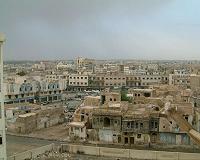
The women ululated as residents waved white flags Sunday in celebration of Iraqi forces who drove Islamic State group jihadists from their eastern Mosul neighbourhood of Al-Khadraa.
"We are raising white flags to show the army that we're peaceful," said shopkeeper Abu Mohammad, a man in his 70s, as he stood outside his store.
Iraqi forces launched a major offensive on October 17 to retake Mosul, which is the country's second city and where jihadist supremo Abu Bakr al-Baghdadi proclaimed a caliphate in 2014.
On Saturday, they drove IS jihadists out of Al-Khadraa after days of fierce fighting.
Abu Mohammad said residents greeted the army with flowers to show their appreciation, and immediately he reopened his shop.
"We are now done" with the jihadists, he said.
But intermittent gunfire and explosions could still be heard in the distance and Iraqi forces say they are still hunting down diehard jihadists who may be hiding in the area.
"There are residents who are cooperating with us," said Lieutenant Nasser al-Ruqabi from the Counter-Terrorism Service (CTS).
He said CTS started working with them Sunday to identify would-be jihadist holdouts and to determine which roads could have been mined by the IS fighters.
But Abu Mohammad is adamant that the situation in Al-Khadraa is under control and that he will not have to flee his home as tens of thousands of Iraqis in the region have in recent weeks.
"We will not leave," he insisted.
A CTS commander, Thaer al-Kenani, said his unit had encouraged residents to hunker down in their homes and raise the white flags for their protection.
"But despite that, the jihadists went inside their homes and inside mosques and used them as hideouts from where they opened fire at us," said Kanani.
– 'We buried our dead' –
With the presence of Iraqi forces in Al-Khadraa, residents have been trying to pick up the pieces of their lives.
Many can be seen cleaning their homes or just walking down the streets, preciously carrying their white flags like a protection shield as if to reassure themselves that everything is back to normal.
Children cooped up for days indoors are also out on the streets and run after a military convoy flashing 'V for victory' signs.
In a house bustling with people, a group of women are crowded in a room talking about their new found freedom after years of living under the brutal rule of the jihadists.
Some like Rima are even planning for the future.
"Yesterday, at 1:00 pm we got rid of them and we were liberated," said Rima who is in her 20s.
"Now I would like to go back to university to continue my studies in Arabic literature," she said.
Her mother, Umm Ahmad Hamdani, interrupts her.
"This is not our house. We live in the building next door, but Daesh (IS) kicked us out, now we are seven families living here," she said.
"We buried our dead in public gardens. Before yesterday we buried three and yesterday two," she added.
Across the street from the house, black plumes of smoke billow into the sky and beyond that a group of residents are walking by, clasping white flags.
– 'Collaborators arrested' –
Umm Akram Juwadiya said she raised a white flag on top of her house two days ago, when the fighting between Iraqi forces and the jihadists intensified.
Since the army entered Al-Khadraa, it has summoned many young men for questioning, including her four sons.
For two-and-a-half-years, Umm Akram and many other mothers endured abuse from the jihadists.
"They used to come almost daily to question my four boys, and now they are being interrogated by the army. I am worried," she said.
But her concern melted and she broke out in tears when she saw the two sons of her neighbour return home after being summoned for questioning by the army.
Umm Akram then rushed outside as a military convoy carrying Lieutenant General Abdul Ghani al-Asadi, a top CTS commander, drove past her house.
"May God make you victorious. Long live Iraq, long live Iraq," she shouts at the soldiers.
Asadi says the residents of Al-Khadraa played a key role in securing the "victory".
"They provided us with information and they helped us. And they also followed the instructions we gave them," he told AFP.
An AFP correspondent on Sunday saw security forces arresting a number of young men.
"They are members of the intelligence unit, and they are arresting people who collaborated with Daesh," Kenani said.
Two Yazidi mass graves found near Iraq's Sinjar
Arbil, Iraq (AFP) Nov 27, 2016 –
Two graves containing the bodies of Iraqi Yazidis believed to have been killed by the Islamic State group have been discovered in northern Iraq, a local official said.
"Two mass graves were found in Um al-Shababik village," Sinjar mayor Mahma Khalil told AFP.
He said the two graves, containing nine bodies each, were about 150 metres from each other, in the western Sinjar region.
Khalil said the authorities were informed and added that the Yazidi Genocide Commission had taken samples.
He said the latest discoveries brought to 29 the number of such graves discovered since anti-IS forces last year retook Sinjar, the minority's main urban hub.
They contain at least 1,600 bodies, he said.
The Kurdish-speaking minority is neither Arab nor Muslim and is mostly based around Sinjar mountain, between the city of Mosul and the Syrian border.
It practices its own religion, a unique blend of faiths which is rooted in Zoroastrianism but borrows from Islam, Christianity and other beliefs.
In August 2014, two months after sweeping across Iraq's Sunni heartland, IS jihadists made a second push into an area that had been under Kurdish security control.
Thousands of Yazidi men were massacred when the jihadists attacked the town of Sinjar and thousands of women and girls were kidnapped and enslaved.
Yazidi community leaders say up to 3,000 Yazidi women may still be at the hands of the jihadists across the "caliphate" they proclaimed more than two years ago over parts of Iraq and Syria.
The UN has called the massacres a genocide, arguing that IS had planned them and then intentionally separated men from women to prevent Yazidi children from being born.
