
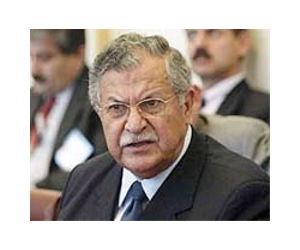
President Jalal Talabani, a key figure in Iraqi politics for decades who has sought to bridge political and sectarian divides, was showing "improvement" in hospital on Wednesday, a doctor said.
"Tests showed the stability and improvement of his excellency's health condition," said Dr Hani Mussa Badr, the director general of Baghdad's Medical City hospital, where Talabani is being treated.
Deputy Health Minister Issam Namiq said both Iran and Germany had sent teams to assist with Talabani's treatment, and that a British team was to arrive by midday.
"We confirm that there is an improvement in comparison to yesterday," Namiq said, adding that no decision had yet been taken on whether or not Talabani would be flown abroad for further treatment.
Talabani was admitted to hospital late on Monday after an emergency that state television reported was a stroke.
A statement from his office on Tuesday said that "bodily functions are normal and the health condition of his excellency the president is stable."
Under Iraq's constitution, "the vice president" takes over if the post of president becomes vacant for any reason, and a new president must be elected by parliament within 30 days.
Vice President Khudayr al-Khuzaie would apparently be the one to temporarily take charge if Talabani dies, both by virtue of being the senior of Iraq's two vice presidents, and because the other, Tareq al-Hashemi, is a fugitive who has been handed multiple death sentences for charges including murder.
Talabani has struggled with a series of health problems in recent years.
He underwent successful heart surgery in the United States in August 2008. The previous year, he was evacuated to neighbouring Jordan for treatment for dehydration and exhaustion.
Talabani has also travelled to the United States and to Europe for treatment for a variety of ailments.
Talabani has been a key figure in Iraqi politics for decades, first as a Kurdish rebel and political leader, and later as the president of Iraq, a post he took up in 2005.
Since becoming president, he has won praise for attempting to bridge divisions between Sunni and Shiite, and Arab and Kurdish factions.
And over the past year, he has repeatedly sought to convene a national conference aimed at reconciling feuding Iraqi leaders.
A married father of two, he has dominated Iraqi Kurdish political life for decades, along with his long-time rival, Kurdistan regional president Massud Barzani, and his family.
After studying law at Baghdad University and a stint in the army, Talabani, who was born in 1933, joined the Kurdistan Democratic Party (KDP) of Mullah Mustafa Barzani, father of Massud, and took to the hills in a first uprising against the Iraqi government in 1961.
But he famously fell out with Barzani, who sued for peace with Baghdad — the start of a long and costly internecine feud among Iraqi Kurds.
Talabani joined a KDP splinter faction in 1964, and 11 years later established the Patriotic Union of Kurdistan (PUK).
The two Kurdish rebel factions were both key allies of the US-led coalition in its 2003 invasion and overthrow of now-executed dictator Saddam Hussein's regime.
