
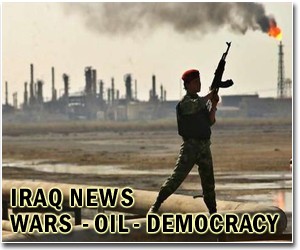
Violence in Iraq dropped dramatically in 2009 to its lowest level since the 2003 invasion, figures showed on Friday, but a monitoring group warned that security gains were levelling off.
Data compiled by the government and an independent monitoring group showed civilian deaths as a result of unrest here fell to their lowest level since the US-led invasion to oust Saddam Hussein.
According to an AFP tally of figures released by the defence, interior and health ministries, a total of 2,800 civilians were killed by violence last year, less than half of 2008's toll of 5,886.
The toll was markedly lower, however, than one compiled by Iraq Body Count (IBC), an independent Britain-based group, which put the number of civilians dead in 2009 at 4,497.
Despite the disparity, IBC's toll was also dramatically lower than its 2008 figures, it said in its annual report.
General David Petraeus, the current US regional military commander and former top general in Iraq, said on Friday that "since I left in September 2008, I have noted progress each time (I returned).
"That is not to say there have not been considerable challenges, there have not been periodic horrific attacks, and that there have not been innumerable obstacles," he told reporters in Baghdad.
"But there has been sustained progress, and that progress has been maintained even after US forces moved out of the cities, and progress continues even as US forces have drawn down."
IBC noted that while there had been "significant improvements" in security in 2009, "such violence still afflicts Iraq's population more than any other."
And the second half of 2009 saw around the same number of civilian deaths as the first, which IBC said "may indicate that the situation is no longer improving."
Prime Minister Nuri al-Maliki has promoted himself as having improved security across Iraq, and is aiming to retain his post after parliamentary elections due on March 7.
But National Security Advisor Safa Hussein warned in an interview with AFP earlier this week that Al-Qaeda is a threat in the run-up to the vote.
"Their intention continues in this direction," he said when asked if he expected further waves of massive coordinated bombings. "I think during the election period, it will continue this way."
IBC added that "large-scale bombings … have increased in their severity of impact," noting that 750 people were killed in eight major attacks last year.
Baghdad in particular was struck by three major coordinated vehicle bombings in August, October and December that killed around 400 people. These attacks were blamed on Al-Qaeda working with diehard elements of Saddam's Baath party.
The US army, meanwhile, said it suffered no combat-related deaths in December, the first month without battle fatalities since the invasion.
Last year was also the least violent for US forces in Iraq, with 150 soldiers having died, compared to 314 in 2008 and 904 in 2007.
In total, 4,371 American soldiers have died since the invasion, according to a tally compiled by AFP based on the independent website www.icasualties.org.
The IBC report also said the restive northern city of Mosul has become more violent than the capital on a per capita basis, with 735 recorded civilian deaths in 2009 out of an estimated population of 1.8 million people.
Baghdad, which has a population of around 6.5 million people, saw 1,488 deaths.
The group added that Mosul experienced nearly twice as many violent incidents as Baghdad.
According to IBC, an emerging trend in terms of types of violence in 2009 was the increasingly prevalent use of magnetic "sticky bombs" secretly affixed to cars: the number of people killed as a result of such attacks rose to 174 in 2009 from 46 in 2008.
Share This Article With Planet Earth
