
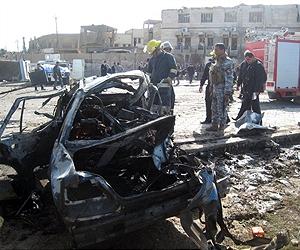
Attacks mainly targeting Iraqi security forces killed five people, among them four policemen, and wounded 16 on Sunday, security and medical officials said.
So far this month, attacks have killed 55 people, 42 of them members of the security forces, according to an AFP tally based on security and medical sources.
In the deadliest attack, gunmen shot dead three police at a checkpoint in a market in Mosul in northern Iraq, police First Lieutenant Khalaf al-Juburi said, a toll confirmed by a doctor from Mosul General Hospital.
In Kirkuk, two roadside bombs killed one policeman and wounded seven others, a security official and a doctor from a hospital in the northern city said.
In Baghdad, a car bomb in the Qahira area targeted the convoy of Brigadier General Mohammed Ghazi, the head of the personal protection directorate in the interior ministry, wounding him, two guards and three civilians, a ministry official said.
A medical official at Al-Kindi hospital, meanwhile, said the facility had received one body and six wounded people, among them three police, including the brigadier general.
The interior ministry official and a medical source also said a sticky bomb wounded a tribal leader in north Baghdad.
And gunmen attacked a checkpoint in the southwestern province of Salaheddin, wounding two police, police and a medic said.
While violence has decreased compared with its peak in 2006 and 2007, attacks remain common across Iraq. There were attacks on 27 of the 31 days in July.
Official figures put the number of people killed in attacks in July at 325, the highest monthly death toll since August 2010.
Turkey PM defends foreign minister's Kirkuk trip
Ankara (AFP) Aug 5, 2012 –
Turkish Prime Minister Recep Tayyip Erdogan on Sunday defended his foreign minister's visit to the disputed northern Iraqi city of Kirkuk last week, which infuriated Baghdad.
It is only normal for "a minister bearing a red passport to visit the regional administration (in northern Iraq) and then travel to Kirkuk, 40 kilometres from (Arbil) to meet with his kinsmen," Erdogan told the ATV television station.
Kirkuk province is part of a swathe of disputed territory in northern Iraq that along with oil contracts are the two main points of contention between Baghdad and the Kurdish regional government in Arbil.
Turkish foreign minister Ahmet Davutoglu made an unannounced trip to Kirkuk last Thursday while on a visit to Arbil for talks with Iraqi Kurdish leader Masoud Barzani.
Davutolgu visited leaders of Kirkuk's Turkmen community, with which Ankara has long had close ties, as well as religious and historical sites including the city's Ottoman cemetery.
The Iraqi foreign ministry said that it was done without approval from Baghdad.
On Sunday, Erdogan said growing energy bonds between Turkey and northern Iraq were also a source of uneasiness for the Baghdad government.
The oil dispute between Baghdad and the Kurdish government in Arbil has worsened, with the autonomous region looking to ramp up oil production and export capabilities. The region has also cut off oil exports to Iraq in a payment row.
Adding to the controversy, Turkey has for months hosted Iraq's fugitive Sunni Arab vice president, Tareq al-Hashemi, who is wanted on charges of running a death squad and is being tried in absentia.
Turkish media recently reported that Hashimi was granted residence permit by Turkish authorities to avoid visa problems during his trips abroad but that was not confirmed by a Turkish foreign ministry spokesman contacted by AFP.
