
Iraq on Saturday asked Ankara to increase the flow of water downstream along the Tigris and Euphrates rivers, as both countries face droughts and tensions over resource management.
Baghdad regularly complains that dams constructed in neighbouring countries impact its river levels.
Water Minister Mehdi al-Hamdani and the Turkish president's special representative for Iraq, Veysel Eroglu, discussed "quantities of water arriving in Iraq through the Tigris and Euphrates" from Turkey, an Iraqi statement said.
Hamdani asked Turkey via videoconference "to re-examine the amounts of water released, in order to allow Iraq to overcome the current water shortage", it added.
Eroglu said he would pass on the request to water authorities in Ankara to "increase the amounts of water released in the coming days, according to (Turkey's) available reserves", according to the Iraqi statement.
Both sides agreed that an Iraqi "technical delegation" would visit Turkey and allowed to "evaluate Turkish dam reserves on site".
The UN classifies Iraq "as the fifth most vulnerable country in the world" to climate change, having already witnessed record low rainfall and high temperatures in recent years.
The issue of managing water resources has raised tensions between Baghdad and Ankara.
On Tuesday, Turkey's ambassador to Iraq, Ali Riza Guney, sparked anger by accusing Iraqis of "squandering" water resources, calling on Twitter for "immediate measures to reduce the waste" including "the modernisation of irrigation systems".
Hamdani responded that Ankara was assuming "the right to reduce Iraq's water quota".
Iraq has seen three years of successive droughts and has halved cultivated agricultural areas for its 42 million inhabitants.
"Water reserves have dropped 60 percent compared to last year," a government official said this Wednesday, Iraq's INA news agency reported.
Water levels arriving from the Tigris and the Euphrates were around a third of the average over the past century, according to the figures.
Iran arrests several after protests at drying lake
Tehran (AFP) July 17, 2022 –
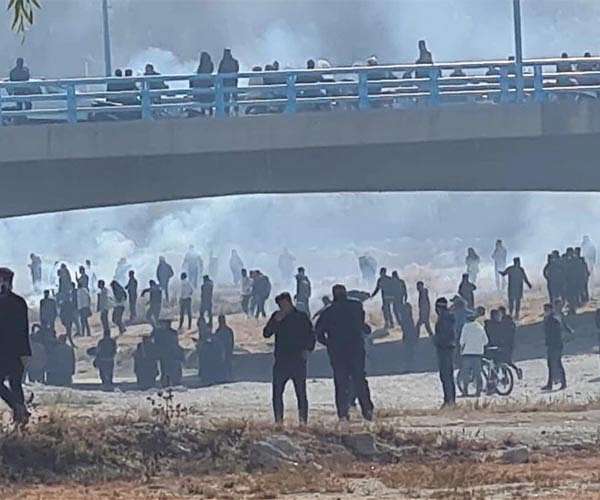
Iranian police have arrested several people for disturbing security after they protested the drying up of a lake once regarded as the Middle East's largest, official media said Sunday.
Lake Urmia, in the mountains of northwest Iran, began shrinking in 1995 due to a combination of prolonged drought, and the extraction of water for farming and dams, according to the UN Environment Programme.
Urmia, one of the largest "hypersaline" — or super salty — lakes in the world, is located between the cities of Tabriz and Urmia, with more than six million people dependent on agriculture around its shores.
On Sunday, Rahim Jahanbakhsh, the police chief of Iran's West Azerbaijan province, reported the arrests.
He described the suspects as "many evil and hostile elements, who had no other objective than to destroy public property and disturb the security of the population," according to state news agency IRNA.
On Saturday, the Fars news agency reported that "dozens of people in the cities of Naghadeh and Urmia had protested against the authorities' lack of attention to the drying up of Lake Urmia".
Fars said protesters had shouted slogans in the provincial capital of Urmia warning the lake was shrinking.
"Lake Urmia is dying, parliament orders its killing", some shouted, Fars reported, with others calling out that "Lake Urmia is thirsty".
Largely arid Iran, like other nearby countries, has suffered chronic dry spells and heat waves for years, which are expected to worsen with the impacts of climate change.
In the last few months, thousands of people have demonstrated against the drying up of rivers, particularly in central and southwestern Iran.
Lake Urmia is an important ecosystems, a key stopping point for migratory birds, and home to an endemic shrimp as well as other underwater species.
