
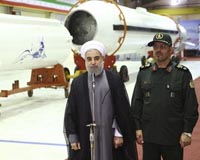
Iran's President Hassan Rouhani dismissed threats made by US Secretary of State Mike Pompeo on Monday, saying the rest of the world no longer accepts Washington making decisions on their behalf.
"Who are you to decide for Iran and the world?" Rouhani said in a statement carried by multiple Iranian news agencies.
"The world today does not accept that the United States decides for the world. Countries have their independence," he added.
It was a pointed response to Pompeo's speech earlier in the day, in which he threatened the "strongest sanctions in history" against Iran unless it capitulated to a series of 12 demands regarding its regional behaviour and missile programme.
But Rouhani dismissed the administration of President Donald Trump as a "move 15 years backwards to the era of Bush junior and a repeat of the same statements as 2003".
"The era of such statements has evolved and the Iranian people have heard these statements hundreds of times, and no longer pays attention," he added.
European leaders have strongly condemned the US move to abandon the 2015 nuclear deal and reimpose sanctions, seeing it as undermining regional security and a direct attack on their economic interests.
Russia and China — two other parties to the agreement — have also criticised the US move and vowed to maintain trade with Iran.
"The world does not accept the logic by which a gentleman who was head of the spy service… decides for others," said Rouhani, referring to Pompeo's recent job as head of the CIA.
Broad Iran deal 'very, very difficult': UK's Johnson
London (AFP) May 21, 2018 –
The "jumbo Iran negotiation" sought by US President Donald Trump will be "very, very difficult" to achieve, British Foreign Secretary Boris Johnson warned Monday.
US counterpart Mike Pompeo on Monday set 12 tough conditions for a "new deal" with Iran after Trump walked away from the existing nuclear agreement.
But Johnson said that he didn't see a comprehensive deal "being very easy to achieve, in anything like a reasonable timetable."
Britain and the other powers who signed the 2015 agreement have vowed to honour the deal, despite the US promising to increase financial pressure on Iran with the "strongest sanctions in history," hampering companies hoping to deal with the Middle Eastern state.
Johnson defended the original deal, saying it "protected the world from an Iranian nuclear bomb, and in return it gave the Iranians some recognisable economic benefits."
He added that G20 foreign ministers would discuss the issue when they meet in Buenos Aires later Monday.
"I think we will be discussing, not in the session but we'll certainly be discussing it with friends and colleagues today, how to take it forward," he told reporters.
"But the prospect of a new jumbo Iran treaty is going to be very, very difficult.
"I think in the end, we will get back to the kind of additions to the JCPOA that we initially envisaged — but it may take a long time," he added.
Johnson said Britain was already taking measures to try to shield British companies dealing with Iran from being hit by US sanctions.
"We're going to do everything we possibly can," he said.
