
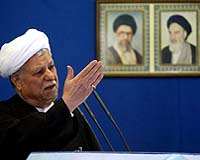
Influential former Iranian president Akbar Hashemi Rafsanjani on Tuesday accused US president-elect Barack Obama of mimicking his predecessor's tough stance on Tehran's nuclear drive.
"I don't expect someone who considers himself to be originally from Africa and a member of the oppressed black race in America to repeat what (George W.) Bush has to say," Rafsanjani said in a sermon on state radio.
In an interview broadcast on Sunday, Obama vowed "tough but direct diplomacy" with Iran, offering incentives along with the threat of tougher sanctions over its atomic programme.
During his term, Bush spearheaded the international campaign against Iran's atomic drive which the United States fears could be a cover for ambitions to build nuclear weapons, allegations denied by Tehran.
The outgoing US president once famously branded Iran as part of an "axis of evil" and never ruled out military action over its nuclear work.
"I advise (Obama)… we don't want your incentives and your punishments will not stop us either," he said in a speech marking the Muslim Feast of the Sacrifice or Eid al-Adha.
"It's better for you to be reasonable and not to deprive Iran of its rights."
The UN Security Council has repeatedly demanded that Iran freeze its uranium enrichment work, the process which makes nuclear fuel as well as the fissile core of an atom bomb, but Tehran has refused.
Iran does not have capability to build nuclear bomb: Moscow
Iran does not currently have the capability to build a nuclear weapon, a senior Russian diplomat was quoted as saying by Interfax and ITAR-TASS news agencies Tuesday.
"One cannot say today that Iran can create nuclear weapons and the means of delivering them," Vladimir Voronkov, head of the Russian foreign ministry's department of European cooperation, was quoted as saying.
"This information is confirmed by all the services responsible for the collection and analysis of information," he added, in an apparent allusion to Russian intelligence agencies.
Contrasting the stances of Russia and the West on Iran's nuclear programme, he said that "the difference is that our partners want to use instruments of pressure. We do not consider such instruments to be always effective."
Russia has resisted tougher sanctions on Iran over its nuclear programme, which the United States and Israel fear is being used as cover to develop an atomic bomb.
Iran vehemently denies the allegations, saying its nuclear programme is civilian in nature and aimed only at generating electricity.
Russia is one of the six countries negotiating with Iran over the nuclear issue along with the United States, Britain, China, France and Germany. It is also helping Iran build a civilian nuclear power plant at Bushehr.
Allegations that Tehran is seeking atomic weapons have raised fears that the United States or Israel could launch a pre-emptive strike to destroy Iran's nuclear facilities.
Share This Article With Planet Earth
