
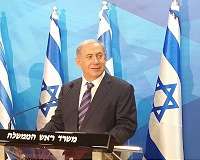
Prime Minister Benjamin Netanyahu said Tuesday that the Iranian plan to increase its nuclear enrichment capacity was aimed at producing nuclear weapons to be used against Israel.
"Two days ago, Ayatollah Khamenei, Iran's supreme leader, stated his intention to destroy the State of Israel," Netanyahu said in a video posted on social media.
"Yesterday he explained how he would do it — by unlimited enrichment of uranium to create an arsenal of nuclear bombs."
"We're not surprised," Netanyahu said in the video from Paris, where he was to meet French President Emmanuel Macron.
"We won't let Iran obtain nuclear weapons."
Iran on Monday notified the International Atomic Energy Agency of its plan to open a centre for the production of new centrifuges to be used for uranium enrichment, according to the head of the Iranian Atomic Energy Organisation, Ali Akbar Salehi.
Salehi stressed the announcement did not mean they will start assembling the centrifuges, and "does not violate the (2015 nuclear) agreement" between Tehran and world powers.
Under the 2015 agreement, Iran can build parts for the centrifuges as long as it does not put them into operation within the first decade.
On Sunday, Iran's supreme leader Ayatollah Ali Khamenei called Israel a "malignant cancerous tumour" that should be removed.
Netanyahu was visiting European leaders to discuss Iran's regional involvement and nuclear programme, both seen by the Jewish state as grave threats.
European powers have been scrambling to preserve the 2015 nuclear deal since US President Donald Trump announced Washington's withdrawal from the treaty last month.
Israel calls for 'military coalition' if Iran boosts enrichment
Jerusalem (AFP) June 5, 2018 –
Israel's intelligence minister called Tuesday for a military coalition against Iran if the Islamic Republic were to defy world powers by enriching military-grade uranium.
Yisrael Katz's remarks came as Israeli Prime Minister Benjamin Netanyahu began visiting European leaders to discuss Iran's regional involvement and nuclear programme, both seen by the Jewish state as grave threats.
European powers have been scrambling to preserve a landmark deal over Tehran's nuclear programme since US President Donald Trump announced Washington's withdrawal from the treaty in May.
Katz addressed Tehran's threat to restart uranium enrichment at an "industrial level" if the 2015 pact falls apart.
"If the Iranians don't surrender now, and try to return" to unsupervised uranium enrichment, "there should be a clear statement by the President of the United States and all of the Western coalition," he said.
"The Arabs and Israel surely would be there too."
The message should be that "if the Iranians return" to enriching uranium that could enable them to build a nuclear bomb, "a military coalition will be formed against them," Katz told Israeli public radio station Kan.
Iran's supreme leader Ayatollah Ali Khamenei on Monday warned European leaders to drop their "dream" of Tehran continuing to curb its nuclear programme despite renewed economic sanctions.
He also called Israel a "malignant cancerous tumour" that should be removed.
The Iran deal paved the way for the partial lifting of international sanctions against the country, in exchange for Tehran curbing its nuclear programme for several years.
Israel argues the lifting of sanctions under the nuclear deal allowed Iran to expand its presence in the Middle East, both through its own forces and with proxy groups.
It also says the time limits on the accord do not guarantee Iran will not eventually obtain nuclear weapons, while it also wants to see restrictions on Iranian missile development.
Iran denies the pursuit of an atomic programme for military purposes.
In his Monday meeting with German Chancellor Angela Merkel, Netanyahu warned that Iran was "seeking nuclear weapons to carry out its genocidal designs."
"It's important to prevent Iran from getting a nuclear weapon. We commit, and I commit again, that we will not let that happen," he said.
Netanyahu will meet French President Emmanuel Macron on Tuesday and British Prime Minister Theresa May on Wednesday.
