
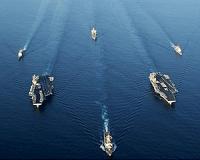
Iran on Monday dismissed as old news a US announcement it is sending a naval strike group to the Middle East in order to deliver the Islamic republic a message, Tasnim news agency reported.
US National Security Advisor John Bolton said on Sunday that the United States was deploying the USS Abraham Lincoln carrier strike group and a bomber task force as a "clear and unmistakeable message" that it will retaliate against any attack on its interests or its allies' by Iran.
"Bolton's statement is a clumsy use of an out-of-date event for psychological warfare," Iran's supreme national security council spokesman Keyvan Khosravi said, quoted by Tasnim.
According to the spokesman, Iranian armed forces had observed the carrier entering the Mediterranean Sea 21 days ago.
Bolton "lacks military and security understanding and his remarks are mostly meant to draw attention to himself," Khosravi added.
The USS Abraham Lincoln has previously been deployed to the Gulf, including during the 2003 US-led invasion of Iraq.
The US statement did not specifically state why the deployment was taking place now.
Secretary of State Mike Pompeo said the United States had seen "escalatory actions" from Iranians and that the country would be held "accountable for attacks on American interests".
Pompeo did not elaborate on the "escalatory actions" he was referring to.
The deployment comes amid heightened tensions as Washington pushes forward with its campaign of "maximum pressure" against Tehran partly through punishing economic sanctions.
The United States unilaterally withdrew from the 2015 Iran nuclear deal with world powers a year ago and instead aimed at curbing the regional role of Iran, an arch-rival of US allies Saudi Arabia and Israel.
In April, the US also declared Iran's elite Revolutionary Guards a "foreign terrorist organisation".
Risks rise as US warns Iran with aircraft carrier
Washington (AFP) May 6, 2019 –
Fears of conflict rose Monday as the US vowed to send a message to Iran by deploying an aircraft carrier strike group, amid a report that Tehran would scale back commitments under a nuclear deal after mounting pressure by President Donald Trump.
Patrick Shanahan, the acting US defense secretary, said he approved the deployment of the USS Abraham Lincoln carrier strike group to unspecified waters in the vicinity of Iran in response to "indications of a credible threat by Iranian regime forces."
"We call on the Iranian regime to cease all provocation. We will hold the Iranian regime accountable for any attack on US forces or our interests," Shanahan tweeted.
The announcement came first on Sunday evening from John Bolton, Trump's national security advisor, who said the move was "a clear and unmistakable message to the Iranian regime that any attack on United States interests or on those of our allies will be met with unrelenting force."
"The United States is not seeking war with the Iranian regime, but we are fully prepared to respond to any attack, whether by proxy, the Islamic Revolutionary Guard Corps, or regular Iranian forces," Bolton said.
US officials did not give more details on the alleged threat, and the Pentagon had already announced in April that the USS Abraham Lincoln had headed on a "regularly scheduled deployment" out of its base in Norfolk, Virginia.
Iran's supreme national security council spokesman Keyvan Khosravi dismissed Bolton's statement, calling it a "clumsy use of an out-of-date event for psychological warfare."
– Based on intelligence, or politics? –
The news site Axios said Bolton's warning came after Israel, which has pushed to isolate Iran, passed along intelligence on a possible plot by Tehran "against a US target in the Gulf or US allies like Saudi Arabia or the UAE."
Quoting an unnamed Israeli official, Axios said the intelligence was "not very specific at this stage" but that the "Iranian temperature is on the rise" due to pressure.
Mark Dubowitz, chief executive of the Foundation for Defense of Democracies, which advocates a hard line on Iran, said he had heard of a "spike" in intelligence in recent days about planned attacks.
He believed Iran had given the green-light to Islamist movements Hamas and Islamic Jihad to fire missiles into Israel in a weekend flare-up to "create a crisis to distract the US and Israel" from plots elsewhere.
Other observers were much more skeptical of the intentions of Bolton, who has advocated attacking Iran and enjoyed close ties to the country's formerly armed opposition before Trump hired him.
"The Trump administration's team of saber-rattling foreign policy advisors are all but openly shouting their desire for an unauthorized and unconstitutional war with Iran," said Senator Tom Udall, a Democrat.
"Congress must act immediately to stop this reckless march to war before it's too late," he tweeted.
The deployment announcement came almost a year to the day after Trump pulled the United States out of a multinational accord under which Tehran drastically scaled back its sensitive nuclear work.
"I think this is manufactured by Bolton to try to justify the administration's very harsh policy toward Iran despite the fact that Iran has been complying with the nuclear deal," said Barbara Slavin, the director of the Future of Iran Initiative at the Atlantic Council think tank.
– Iran frustration mounting –
With frustration mounting in Iran over the lack of dividends from the nuclear accord, the semi-official ISNA news agency said that President Hassan Rouhani would announce "retaliatory measures" on Wednesday to mark the anniversary of the US pullout.
The news agency said that Rouhani would invoke sections of the accord under which Iran can cease some or all of its commitments if other parties fail to adhere to their part, notably on ending sanctions.
The Trump administration instead has imposed sweeping sanctions on Tehran and in recent weeks has hit even harder, moving to ban all countries from buying Iran's oil, its top export, and declaring the Revolutionary Guards to be a terrorist group — the first such designation of a unit of a foreign government.
UN inspectors say that Iran has remained in compliance with the nuclear deal, which is still backed by European powers as well as Democrats seeking to unseat Trump next year.
Britain, France and Germany have set up a special payments system to let European businesses operate in Iran and avoid US sanctions, although few firms have been willing to incur Washington's wrath.
