
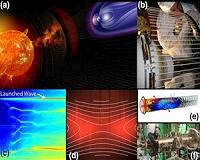
Each second, the sun hurls millions of tons of hot, charged plasma gas into space. This volatile "solar wind" buffets the magnetosphere, the magnetic field that surrounds the Earth, and can whip up geomagnetic storms that disrupt cell phone service, damage satellites and blackout power grids. Precise predictions of such outbursts could prompt measures to cope with them, just as forecasts here on Earth warn of approaching hurricanes and thunderstorms.
Researchers throughout the United States are using laboratory experiments to uncover important physics behind this space weather. Their latest results will be presented at the annual meeting of the American Physical Society's Division of Plasma Physics in New Orleans. Among their findings:
+ Experiments at Princeton Plasma Physics Lab show in detail how magnetic reconnection, an explosive phenomenon that occurs in solar flares near the sun, accelerates solar wind particles to high energy, and how the resulting solar wind interacts with the magnetic field that shields the earth.
+ Using a plasma "wind tunnel" at Swarthmore College, professor Michael Brown and post doc David Schaffner are now able to simulate the key signatures of magnetic turbulence seen in the solar wind and expected to play a role in astrophysical jets driven by exploding stars.
+ A team of scientists on the Large Plasma Device (LAPD) at UCLA has recorded laboratory observations of interactions between plasma magnetic waves. These waves are known to ripple through the turbulent solar wind where theory and satellite measurements suggest the observed interactions may help explain the behavior of the hot plasma.
+ Columbia University graduate student Thomas Roberts and his advisor, using a chamber filled with plasma and magnetic fields simulating the earth's magnetosphere, have discovered a possible connection between ionospheric currents and local space weather near the earth.
Following are key results of five leading studies of physical processes that researchers have conducted in the laboratory to understand what happens in space, where the ability to make measurements is far more limited.
How Magnetic Reconnection Goes "Boom!"
Magnetic reconnection, in which the magnetic field lines in plasma snap apart and violently reconnect, creates massive eruptions of plasma from the sun. But how reconnection transforms magnetic energy into explosive particle energy has been a major mystery.
Now scientists at the U.S. Department of Energy's (DOE) Plasma Physics Laboratory (PPPL) have taken a key step toward solving the mystery. In research conducted on the Magnetic Reconnection Experiment (MRX) at PPPL, the scientists not only identified how the transformation takes place, but measured experimentally the amount of magnetic energy that turns into particle energy. This work was supported by the DOE Office of Science.
The investigation showed that reconnection in a pro-typical reconnection layer converts about 50 percent of the magnetic energy, with one-third of the conversion heating the electrons and two-thirds accelerating the ions – or atomic nuclei – in the plasma. In large bodies like the sun, such converted energy can equal the power of millions of tons of TNT.
"This is a major milestone for our research," said Masaaki Yamada, the principal investigator for the MRX. "We can now see the entire picture of how much of the energy goes to the electrons and how much to the ions in a prototypical reconnection layer."
