
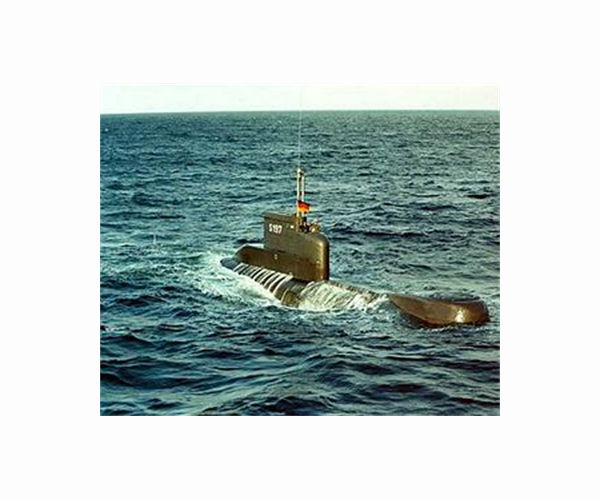
Indonesian navy ships on Thursday scoured a patch of ocean off the coast of Bali searching for a submarine with 53 crew aboard after losing contact with the vessel during military exercises.
The German-built KRI Nanggala 402 was scheduled to do live torpedo exercises when it asked for permission to dive early Wednesday morning, authorities said.
"After permission was given according to the procedure, the submarine lost contact and could not be reached," the defence ministry said.
A helicopter looking for the missing vessel spotted an oil spill in waters where the submarine was thought to have submerged, it added.
The navy said it has not pinpointed the submarine's location but narrowed the search down based on the spill.
The oil "could indicate damage on the body" of the submarine, navy spokesman Julius Widjojono told MetroTV.
Two warships and some 400 personnel were sent out to hunt for the sub, while a third vessel was deployed from the capital Jakarta.
The navy also sent out an international distress signal and "several countries have responded and are ready to help including Singapore, Australia and India," the defence ministry said.
There were 53 crew aboard the vessel, which was believed to be in waters about 700 metres (2,300 feet) deep.
Indonesia, which has been moving to upgrade its military equipment in recent years, has five German and South Korean-built submarines in its fleet.
The 1,300-tonne KRI Nanggala 402 was built in 1978, according to a government website.
The vessel is a Type 209 diesel-electric attack submarine that has served in more than a dozen navies around the world, including Greece, India, Argentina and Turkey, over the past half century.
"It's a classic submarine," French navy vice admiral Antoine Beaussant told AFP.
It had a safety descent level of 250 metres, and "if it went down to rest at 700 metres the likelihood is it would have broken up," he said.
– Submarine disasters –
While the Southeast Asian archipelago has not previously suffered a major submarine disaster, other countries have been struck by accidents in the past.
Among them was the 2000 sinking of the Kursk, the pride of Russia's Northern Fleet.
The submarine was on manoeuvres in the Barents Sea on August 12, 2000 when it sank with the loss of all 118 aboard. An inquiry found a torpedo had exploded, detonating all the others.
Most crew died instantly but some survived for several days — with a few keeping heart-breaking diaries written in blood to their loved ones — before suffocating.
Seventy Chinese naval officers and crew were killed, apparently suffocated, in an accident on a Ming-class submarine conducting exercises in 2003.
In 2008, 20 people were killed by poisonous gas when a fire extinguishing system was accidentally activated on a Russian submarine being tested in the Sea of Japan.
In 2018, authorities found the wreckage of an Argentine submarine that had gone missing a year earlier with 44 sailors aboard.
Crushed from an implosion, the ARA San Juan was located at a depth of more than 900 metres (3,000 feet) in an area of undersea craters and canyons 400 kilometres (250 miles) off the coast of Argentina.
In 2019, a French submarine that had gone missing in the Mediterranean more than 50 years earlier was found.
The diesel-electric Minerve submarine was lost off France's southern coast with 52 sailors on board on January 27, 1968.
Experts believe that the disaster was caused by a problem with the Minerve's rudder, a collision with another boat, the explosion of a missile or torpedo, or a fault with its oxygen supply systems.
The worst submarine accidents
Paris (AFP) April 21, 2021 –
Here are the worst submarine disasters, after Indonesia lost contact with the KRI Nanggala 402 with 53 crew aboard off the coast of Bali at a depth of 700 metres (2,300 feet).
– Russia's Kursk, 118 die –
In August 2000, Russia's northern fleet nuclear submarine Kursk catches fire and explodes underwater while conducting war games.
Russian authorities controversially initially refuse help from British and Norwegian naval vessels, and all 118 sailors on board the submarine are killed.
Most die instantly but some survive for several days — with a few keeping heart-breaking diaries written in blood to their loved ones — before suffocating.
It is the Russian navy's worst-ever disaster.
– Chinese navy, all 70 killed –
Seventy Chinese naval officers and crew are killed, apparently suffocated, in an accident on a Ming-class submarine conducting exercises east of the Neichangshan islands in May 2003.
The government says only there were "mechanical problems".
– Argentina's San Juan, 44 lost –
The San Juan, a 34-year-old German-built diesel-electric sub, goes missing with 44 crew aboard in the South Atlantic in mid-November 2017.
It is located at a depth of 900 metres and 400 kilometres (250 miles) from the coast of Patagonia, after a search of more than a year in which several countries take part.
According to the navy, the submarine exploded due to a mechanical breakdown.
– Fire on Soviet vessel, 42 die –
In April 1989, a fire following a short circuit breaks out on board a Soviet nuclear submarine, the Komsomolets, while it is in international waters 500 kilometres from Norway.
The crew is not able to put out the fire and quickly brings the vessel to the surface. Dozens dive into the glacial waters to escape, only a few taking to lifeboats.
Some drown but most of the 42 dead are taken down in the submarine when it sinks. Twenty-seven people survive.
– Other accidents –
In March 1979 the Eurydice disappears off the French Mediterranean resort of Saint-Tropez with 57 aboard. The French submarine disintegrated after exploding. Debris is identified the following month at a depth of 900 metres.
Ninety-nine sailors die in May 1968 in an American nuclear submarine, the Scorpion, which disappears in the Atlantic, probably sunk by one of its torpedoes.
Also in 1968 the Soviet K-129 submarine armed with three nuclear missiles disappears with its 98 crew some 2,500 kilometres from Hawaii in the North Pacific.
The United States later finds the wreck 5,000 metres below the surface and organises its recovery in a covert operation in 1974.
The Minerve, the jewel of France's navy, disappears off Toulon in southern France in January 1968 with 52 sailors on board.
Despite immediate rescue operations, the wreck will only be located half a century later, in July 2019, 45 kilometres from the coast. It has been cut in three.
The Dakar, an Israeli vessel carrying out its maiden voyage with 69 men on board, disappears in January 1968 and is only found off the Greek island of Crete in 1999.
In April 1963 the USS Thresher sinks with 129 people aboard off Cape Cod some 400 kilometres from the northeastern US coast. It is the first American nuclear submarine lost at sea.
