
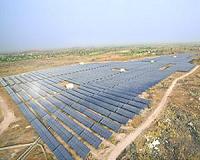
Basking in sunshine for an average of 300 days every year, the Republic of India may be set to become the eventual champion of solar power producing nations. Experts have put the nation's theoretical solar electricity output from land sources alone at some 5,000 trillion kilowatt-hours annually, the largest sovereign potential in the world.
Such tremendous upside is not lost on executives of solar power systems designer Wave Energy. From its base on the southern island of Shikoku, it has installed 1,179 solar generating units nationwide totaling about 580 megawatts.
Less than a year ago, Wave hired Indian engineer Ajit Bhandari to help facilitate its Indian dreams. It has since set up an office in Hyderabad, the capital of the southern state of Telangana.
The May 2014 election of Narendra Modi as Prime Minister of India may help facilitate the nation's solar push, says Mr. Bhandari. India's first 5 megawatts of solar capacity was installed only in 2011.
"Modi seems very friendly to the idea of a nationwide solar buildout. The current goal is to spend the equivalent of $100 billion to achieve 100 gigawatts of solar capacity by 2022. It is hoped that Japanese solar know-how will help to make this a reality."
India's plan is part of the Modi's broader goal to modernize its infrastructure, ranking railways and highways among top priorities. In December 2015, Japan and India agreed to jointly build a bullet train system linking Mumbai and Ahmedabad in the country's western region.
But the nation's energy needs are even more chronic, and several regions cannot keep up with growing demand. In Mumbai, India's most populous city with 18.4 million people, current power supply totals 3,416 megawatts versus demand projected to top 4,350 megawatts by 2021.
The state of Tamil Nadu on India's southern tip had set an ambitious goal to boost its installed solar capacity by 15-fold to over 3,000 megawatts by 2015, using a combination of tax rebates and other incentives for industries residential buildings.
In all, more than 300 million of India's 1.3 billion people (23%) live without any electricity, while millions more have only spotty service from the grid.
The Prime Minister has pledged to create dozens of "ultra mega solar power parks," of 500-plus megawatts, while the National Institute for Rural Development has a program to bring rooftop solar panels to thousands of impoverished villages. India's Assured Power Purchase Agreement guarantees the purchase of solar power by state and central governments.
Plenty of obstacles remain, however. India is still coal-dependent. The amount of acreage required for utility-scale solar power plants puts a strain on available land resources. The infrastructure needed to carry electricity to villages and homes-let alone to produce it more cleanly and efficiently-needs to be built out as well.
It's also a competitive market, with companies from China, Spain, the U.S., and others also jockeying to enter the country, says Mr. Bhandari.
Still, if properly addressed, the solar energy available in India in one year could exceed the possible energy output of all fossil fuel reserves, studies say.
"We are still collecting data, and plan to begin submitting solar power bids for projects from next year," says Mr. Bhandari. "We are hopeful for success."
"(India’s) current goal is to spend the equivalent of $100 billion to achieve 100 gigawatts of solar capacity by 2022. It is hoped that Japanese solar know-how will help to make this a reality." — Ajit Bhandari
