
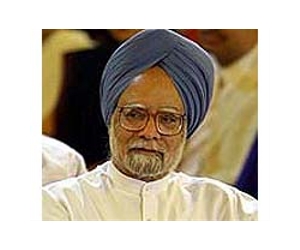
China is seeking to expand its influence in South Asia and gain a "foothold" in the region, Indian Prime Minister Manmohan Singh said in remarks published Tuesday.
"China would like to have a foothold in South Asia and we have to reflect on this reality," Singh was quoted as saying by The Times of India on Tuesday. "We have to be aware of this."
Following recent meetings with the Chinese leadership, he said there was a desire in Beijing to sort out differences between the two emerging powers, whose relations are wracked by tension and mistrust.
"This leadership will change in two years. There is a new assertiveness among the Chinese. It is difficult to tell which way it will go. So it's important to be prepared," he added.
India is watchful of China's growing presence in the region, including its major investments in ports being built in Bangladesh, Sri Lanka and Pakistan.
New Delhi was put on guard about China's growing naval power at the end of last month when two Chinese ships docked in neighbouring Myanmar to take part in a series of military exercises.
Border disputes in northeastern and northwestern India, a short war in 1962 and the presence in India of Tibet's spiritual leader, the Dalai Lama, all contribute to an atmosphere of suspicion between the Asian giants
China is also a close ally of Pakistan — India's regional foe — supplying investment, industry know-how and weapons, including missile technology, according to New Delhi.
earlier related report
Asia's 'middle powers' seek to balance China: think-tank
London (AFP) Sept 7, 2010 –
Asian "middle powers" are trying to increase their diplomatic and military clout in a bid to counter China's growing power, an international think-tank said in a report on Tuesday.
Indonesia, South Korea and Australia in particular were seeking ways for countries to work together across the region, the London-based International Institute for Strategic Studies said.
Their moves were part of a general trend around the world as the United States and other western nations suffer aftershocks from the global financial crisis and the drain of involvement in Afghanistan.
"This tendency is pronounced in Asia, but also evident elsewhere, and rising and super-middle powers are asserting their interests more strongly," it said in its "Strategic Survey 2010" annual review.
It said there was a "growing awareness of the relentless growth of Chinese economic and military power and a feeling that China asserts itself more in the region."
"Australia, Indonesia and South Korea appear to be interested in forms of middle-power consultation, to ensure that their interest in a multi-polar Asia is preserved," it said.
South Korea was "developing a brand of middle-power activism" which includes making alliances outside the region — for example a nuclear power project with the United Arab Emirates, the report said.
Australia and Vietnam had notably increased their defence spending and invested in submarines and other military technology to deter future Chinese "adventurism."
Asian countries were also pressing for the involvement of China's fellow Asian giant India as a "balance" for China, though the two offer "comfort" to each other on their stance against the West on climate change.
China's growing confidence was bolstered by riding out the financial crisis more quickly than other countries, the report said, but its increased assertiveness came at a time of growing wariness between Beijing and Washington.
China however faced growing expectations to play a role in addressing world challenges such as tensions over climate change, the report said.
India and China were also "sometimes brought into uncomfortable strategic contact along their own border", particularly in Pakistan, Sri Lanka and Myanmar, it said.
Share This Article With Planet Earth
