
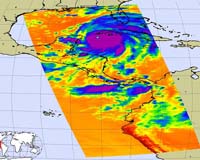
Hurricane Ivan battered US crude oil production to a 50-year low in September and repairs to Gulf of Mexico operations may not finish before 2005, officials and analysts said Wednesday.
Disruptions in the Gulf of Mexico, along with temporary dips in Alaskan operations, cut US output 15 percent from last year to 4.85 million barrels per day, according to the private American Petroleum Institute.
It was the lowest monthly output rate in half a century.
The Gulf of Mexico region usually produces about 1.7 million barrels of oil per day.
But latest government figures showed 471,328 barrels per day were still out of production.
Based on preliminary information supplied by operators, 150,000 barrels per day may be back on line by the end of October, according to the Department of Interior's Minerals Management Service (MMS).
But for the longer term, the agency said operators could only promise that about 96 percent of the normal daily Gulf of Mexico production "should be back on line within six months."
"We have already lost 19 million barrels so far and it looks like by the time we're done with repairs it is going to be closer to 30 million barrels," said PFC Energy analyst Jamal Qureshi.
Ivan, which careened into the Gulf of Mexico September 16, may be the most damaging hurricane yet for the oil industry.
Ten platforms in the Gulf are still evacuated.
The hole in US supplies is widely blamed for pushing up the oil market, where New York's light sweet crude price has jumped about 60 percent since the start of this year.
Unlike other, sometimes more powerful hurricanes that crossed the southwestern United States in mid-August – Charley, Frances, Jeanne – or others of previous years, Ivan's trajectory took it on a particularly devastating path for the oil industry.
Its point of impact was to the west of Florida, in Alabama, near the mouth of the Mississippi, a region hosting a quarter of the US petroleum infrastructure.
"Ivan had a very heavy concentration in production areas," Qureshi said.
The result: landslides, massive waves and powerful winds damaged 16,000 kilometers (10,000 miles) of pipelines and 150 platforms.
ChevronTexaco, Shell, El Paso and Noble Energy were among the worst hit.
"The companies are engaged in around the clock repair operations and only bad weather is slowing down further progress," MMS Gulf of Mexico regional director Chris Oynes said in the service's latest report October 8.
Pipelines in mud slide areas off the mouth of the Mississippi River failed and would require a "significant effort" to locate and repair because they were buried in 20 to 30 feet (seven to 10 meters) of mud, the MMS said.
