
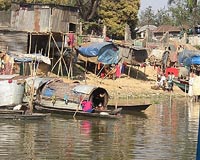
Environmental damage, shoddy urban planning, corruption and other man-made problems are magnifying the human cost of natural disasters almost every time they strike in Asia, experts said.
Thousands of people have died across the region this week in a relentless string of events that at first may seem to be the fault of Mother Nature, but the enormous death tolls can be equally blamed on people, they said.
Rafael Senga, a Filipino environmental expert with the World Wildlife Fund, said deforestation, the ever-expanding number of people living in dangerously planned cities and man-made induced climate change were all major problems.
"It's a combination of factors that can lead to a perfect storm for disaster in the region," Senga told AFP by phone from Bangkok, where he is attending United Nations climate change talks.
"The aggravating effect of environmental degradation, deforestation and climate change is massive."
In the Philippines, more than 270 people died as tropical storm Ketsana pounded the nation's capital, Manila, and the government was quick to point out that those rains were the heaviest in more than four decades.
But, in a flood-prone city, it was no surprise that many of the people killed were from over-crowded shanty towns built along rivers with extremely poor drainage.
Residents of Marikina town east of Manila, which was among those badly hit by the flooding, also noticed that the floodwaters were thickened by soil apparently washed down from surrounding mountains that had been logged.
"It was not water that flooded us. It was mud," said Joanna Remo, chief medical doctor at the Amang Rodriquez Medical Center in Marikina.
Meanwhile, thousands of people are believed to have died in the Indonesian city of Padang following a 7.6-magnitude earthquake on Wednesday.
But geologists have long said Padang was highly likely to suffer a major quake, yet it housed nearly a million people often in poorly constructed buildings.
Similarly, parents blamed poorly constructed school buildings for the large number of deaths among children in last year's quake that hit Sichuan province, China, and killed 87,000 people in total.
The inexorable urbanisation of Asia brings with it a myriad of problems that exacerbate natural disasters, experts say.
"The outcome of Asia's high rate of urbanisation has been the expansion of urban populations into geographic areas, which are frequently affected by disaster events," the Bangkok-based Asian Disaster Preparedness Centre said on its website.
"The result is an increased vulnerability of populations and infrastructure." It said mitigation measures such as earthquake and cyclone-resistant buildings, flood and landslide control measures and the incorporation of disaster vulnerability into land-use planning "have rarely been attempted in most Asian countries."
That problem is likely to worsen.
By 2030, five billion people worldwide are projected to live in urban areas, up from 3.3 billion in 2008, according to the Asian Development Bank.
The number of cities with populations of more than one million each are expected to jump to more than 500, up from only 11 from the beginning of the last century, it said, citing UN figures.
More than half of those cities will be in Asia, it added.
A Singapore-based regional economist said Asia's "reckless path" to economic development as well as corruption should also be blamed for the high number of casualties in disasters.
"In the rush to achieve high economic growth, short-cuts are sometimes taken," said the economist who asked not to be named because his company had businesses in the countries involved.
In 2007, 75 percent of all people killed from natural calamities came from Asia, the global charity World Vision said in a report late last year.
earlier related report
Concern for Philippine flood orphans
Welfare workers say they are tracking the whereabouts of potentially hundreds of children who lost their parents in devastating weekend floods that submerged most of the Philippine capital.
And there was growing concern the new orphans could be driven out on to the streets, joining hundreds of thousands of other children who are fending for themselves in cities across this impoverished Southeast Asian nation.
Poor communities living in hazard-prone slums along riverbanks bore the brunt of devastation when six-metre (20-feet) floodwaters unleashed by tropical storm Ketsana swamped Manila and surrounding regions on Saturday.
The disaster claimed at least 277 lives, according to the official toll, although that number is expected to rise as authorities establish a clearer picture of the carnage.
Natalie Lamin, child protection chief of the United Nations Children's Fund (UNICEF) office in the Philippines, said her organisation was working to quickly determine how many children were orphaned by the deadly floods.
"We hope to be able to establish a database by next week," she told AFP.
More than 200 volunteers are now trying to track down the orphans, who may have sought refuge in the hundreds of shelters set up in schools and other public buildings around Manila, Lamin said.
The child protection agency is working in partnership with the Philippine government's social welfare department.
Brothers Roderick and Michael Luces, aged 17 and 19 respectively, have been left to rely on donated clothes from classmates and food handouts after losing both their parents and four of their siblings on Saturday.
The family was washed away by the rising waters of a river in the city's Bagong Silangan district. The brothers have since been living with thousands of other people at a local gymnasium turned into an evacuation centre.
"Everything was swept away. We don't have any money. We're just begging for food here," said their 25 year-old sister, Agnes, who is married with two children of her own.
"I guess they will have to stay with me."
Orphaned children had the best chance of avoiding a life on the street if they remained in the same community, preferably under the care of relatives or even neighbours, Lamin said.
When neither is available, it is only then that social welfare services ought to look at other options, she added.
"Being in a community adds an extra layer of protection if a family or a community is looking after their children," Lamin said.
Share This Article With Planet Earth
