
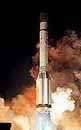
Hughes Space and Communications Co., the world's leading supplier of commercial communications satellites, set a new company record yesterday with the near-simultaneous launch of two satellites, one from Kourou, French Guiana, and one from the Baikonur Cosmodrome in Kazakhstan.
First signals have been received from both spacecraft, indicating
normal operation.
JCSAT-5, the fifth satellite built for Japan Satellite Systems Inc.
(JSAT), by Hughes Space and Communications Co. lifted off at 7:52
p.m. local time (2:52 p.m. Dec. 2 in Los Angeles, 10:52 p.m. Dec. 2
GMT) aboard an Ariane 44P rocket. The spacecraft separated from
the launch vehicle about 21 minutes later. About an hour after
launch, JSAT's Yokohama Satellite Control Center received its first
signals from the spacecraft, confirming it is operating normally.
JCSAT-5 is the 36th Hughes HS 601 body-stabilized model satellite.
It will relay voice, data and television signals among Japan, the
Asia-Pacific region and Hawaii. With its solar panels generating
approximately 5,000 watts, the satellite will operate 32 active
transponders in Ku-band. It is expected to provide at least 12 years
of service from its orbital slot of 150 degrees East longitude.
Astra 1G, also the fifth Hughes-built satellite for Societe
Europeenne des Satellites (SES) of Luxembourg, lifted off at 4:11
a.m. Dec. 3 local time (3:11 p.m. Dec. 2 in Los Angeles, 11:11
p.m. Dec. 2 GMT) from the Baikonur Cosmodrome in Kazakhstan aboard
a Proton rocket. The spacecraft separated from the launch vehicle
nearly seven hours later. About 6:52 a.m local time satellite
controllers in Sydney received signals from Astra 1G, indicating
systems are operating normally.
Astra 1G is the second HS 601HP (for high-power) satellite to be
launched by Hughes, and the 37th HS 601. The spacecraft features 7
kilowatts of power, made possible through the use of state-of-the-art
gallium arsenide solar cells. These cells, developed by another unit
of Hughes Electronics, Spectrolab Inc., are nearly one-and-a-half
times more efficient than traditional silicon solar cells.
Astra 1G will join SES's existing satellite fleet to expand
television, radio and multi-media services throughout Europe. The
spacecraft features 32 active transponders during its first five
years of operation, with 28 thereafter, operating in the Broadcast
Satellite Service and Fixed Satellite Service frequency bands,
powered by 98-watt traveling wave tube amplifiers. As with the other
Astra satellites, SES will be able to change the transponders'
transmission frequencies in orbit to accommodate new programming or
to back up the other satellites. Astra 1G also has an advanced
antenna design, using two large lightweight reflectors featuring
Hughes' contoured-surface technology. The satellite will be
stationed at 19.2 degrees East longitude and will have a service life
of 15 years.
