
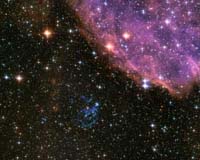
Reminiscent of a U.S. Independence Day celebration, here is a NASA Hubble Space Telescope image of a cosmic explosion that is quite similar to fireworks on Earth. In the nearby Small Magellanic Cloud, a massive star has exploded as a supernova, and begun to dissipate its interior into a spectacular display of colorful filaments.
The supernova remnant known as E0102 is the greenish-blue shell of debris just below the center of the Hubble image. Its name is derived from its coordinates in the celestial sphere.
More formally known as 1E0102.2-7219, it is located almost 50 light-years away from the edge of the massive star-forming region, N 76, also known as Henize 1956 in the Small Magellanic Cloud. The delicate structure, glowing in a multitude of lavenders and peach hues, resides in the upper right of the image.
Determined to be only about 2,000 years old, E0102 is relatively young on astronomical scales and is just beginning to interact with the nearby interstellar medium.
Young supernova remnants such as E0102 allow astronomers to examine material from the cores of massive stars directly, which provides insight on how stars are formed, their composition and the chemical enrichment of the surrounding area.
Young supernova remnants also constitute a great learning tool for understanding the physics of supernova explosions.
Astronomers observed E0102 in 2003 with the Hubble Advanced Camera for Surveys. The image combines observations through four filters that isolate light in the blue, visible and infrared wavelengths and hydrogen emissions with oxygen emission images of the remnant taken with the Wide Field Planetary Camera 2 in 1995.
The Small Magellanic Cloud is a dwarf galaxy very near the Milky Way. It is visible in the Southern Hemisphere, in the direction of the constellation Tucana – the Toucan – and lies roughly 210,000 light-years distant.
