
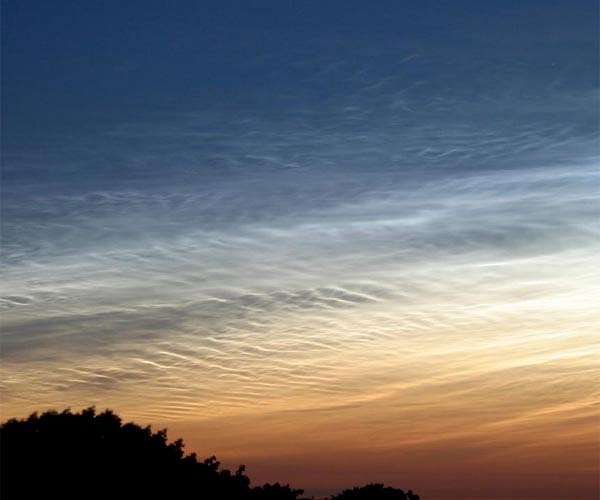
New research, based on two decades' worth of data, shows that in the ten years after its onset in 2000, the Southwestern North American (SWNA) megadrought caused a 30% change in gravity wave activity in Earth's upper atmosphere.
More than 30 years ago, Chester Gardner of UIUC's Department of Electrical and Computer Engineering and Chiao-Yao She of Colorado State University's Department of Physics teamed up to study Earth's middle atmosphere. Using sodium resonance laser radar (lidar), Gardner and She developed and demonstrated an important new technique for measuring temperature profiles in the Earth's upper atmosphere.
Subsequently, they were able to observe changes in upper atmosphere gravity waves at two locations (Albuquerque, New Mexico and Ft. Collins, Colorado) over a 20-year period. Their results, describing how the waves changed following the drought's onset, have now been published in Geophysical Research Letters.
In 1994, a team led by Gardner installed a lidar system on a large telescope at the Starfire Optical Range outside of Albuquerque, NM on the Kirtland Air Force Base. The lidar system measured temperature and winds in the upper atmosphere, using atomic sodium as the target species until late 2000. Cosmic dust particles that are vaporized in Earth's atmosphere are the source of this atomic sodium. Using a laser beam, atomic sodium can be excited, causing it to glow.
A telescope on the ground collects the backscattered light of the sodium fluorescence and computers process that information to derive profiles of sodium density, temperature, and radial wind velocity. She's team at CSU made similar observations at Ft. Collins, CO, eventually compiling an extensive dataset that spanned 20 years from 1990 to 2010.
The discovery of wave activity changes during the megadrought was a fortunate byproduct of other research. The researchers were studying how temperature and winds fluctuated in the upper atmosphere because of waves generated in the lower atmosphere and were surprised to find considerable gravity wave activity changes after the drought onset.
"We never expected to make observations that would yield some insight into how a drought might affect Earth's upper atmosphere," Gardner says.
After taking a look at Gardner's data from Albuquerque and She's data from Ft. Collins, what they found was a significant reduction (~30%) in wave activity after the drought began. The changes in gravity wave activity may be related to reduced wave generation by tropospheric storms during the megadrought and to an altered geographic distribution of precipitation events in the Western and Midwestern United States. Simply put, less precipitation means fewer storms, so fewer waves are being generated by storms.
Research Report:Signature of the Contemporary Southwestern North American Megadrought in Mesopause Region Wave Activity
