
Johns Hopkins University's Applied Physics Laboratory announced Wednesday it will develop and operate twin NASA spacecraft, scheduled to be launched in 2012, intended to study how the Sun interacts with Earth's radiation belts.
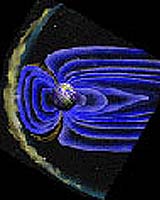
Part of NASA's Living With a Star Program, the Radiation Belt Storm Probes mission will determine how varying inputs of solar energy form or change populations of relativistic electrons and ions in Earth's radiation belts – the doughnut-shaped bands of charged particles trapped by Earth's magnetic field that extend some 20,000 miles around the planet.
After launch, the RBSP spacecraft will measure the distributions of charged particles as well as the electric and magnetic fields that energize, transport or remove the particles within these belts.
Detailed design of the probes will begin this summer, after NASA selects the spacecraft science instruments. The mission's science results will provide the understanding needed to predict potentially hazardous space weather effects, much in the same way scientists forecast weather on Earth.
Observations from the spacecraft also will be used to improve the characterization of planetary space environments, which should permit better design and operations of new technology on Earth and in space.
"For the first time, several spacecraft will simultaneously watch activity on the Sun and the reaction to that activity within Earth's radiation belts," said Ken Potocki, APL's Living With a Star program manager. "These probes will have to work in an incredibly difficult radiation environment where charging and discharging will occur, a lot like flying into an electrical storm."
RBSP is the first project assigned to APL under a 12-year contract, awarded in December 2000, to design, develop and operate missions in the Living With a Star and Solar Terrestrial Probes programs. APL's experience in developing spacecraft to study the sun-Earth relationship includes the TIMED satellite, currently examining solar effects on Earth's upper atmosphere, and the twin STEREO probes, which after launch this summer will begin taking the first 3-D images of solar events called coronal mass ejections.
Other APL spacecraft include the Charge Composition Explorer, one of three spacecraft in the international Active Magnetospheric Particle Tracer Explorers program of the 1980s. It measured the composition of magnetospheric particles, as well as the variations of the particles over space and time.
In all, APL has built 62 spacecraft and more than 150 space instruments.
