
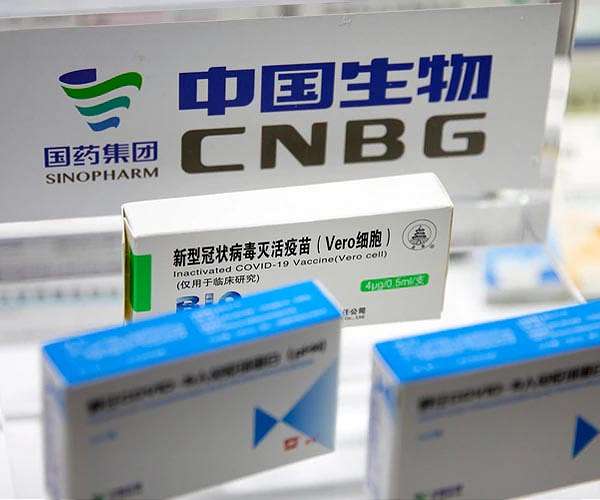
Hong Kong health authorities have ejected a private clinic from the city's coronavirus vaccination programme after it reportedly recommended the German-made Pfizer/BioNTech shot to patients over the one from China's Sinovac.
The move illustrates the Hong Kong government's sensitivity to any criticism of the Sinovac vaccine, which has a comparatively lower efficacy rate and was fast-tracked by regulators despite a lack of published data.
The city's health department said Tuesday that the clinic would no longer administer Covid-19 jabs because a doctor violated an agreement with the inoculation programme.
Authorities said they had also reclaimed unused Sinovac doses from the clinic.
The announcement came after a photo of a notice at the clinic comparing the two vaccines' efficacy rates went viral online over the weekend.
"Advice: don't take Sinovac, take BioNTech," the notice read, adding one of the clinic's own doctors had chosen the latter.
Ta Kung Pao, a newspaper that answers to Beijing's Liaison Office in Hong Kong, then ran a report accusing the doctor of "smearing" the Sinovac vaccine.
So far some 403,000 Hong Kongers — about five percent of the city's population — have received their first doses.
More than 250,000 of them got the Sinovac jab, while the rest got Pfizer-BioNTech shots.
Separately on Wednesday, the government suspended the Pfizer shot due to a packaging problem, but stressed it did not believe there was a safety risk.
– Limited data –
China's coronavirus vaccine makers have been less forthcoming than their competitors in publishing peer-reviewed data from clinical trials — even as Beijing pushes those shots around the world as an alternative to Western-made shots.
The Sinovac shot was approved by Hong Kong after the company submitted data directly to regulators, not to a peer-reviewed medical journal.
Data on the jab from trials in other countries points to efficacy of between 50-80 percent, depending on the studies, compared with Pfizer/BioNTech's 94-95 percent.
Hong Kong began its vaccination drive last month but the public take-up has been slow and ensnared by roiling distrust of China, fuelled by Beijing's sweeping crackdown on the city's democracy movement.
A recent poll said only 37 percent of adults planned to get vaccinated.
Hong Kong leader Carrie Lam has previously lamented the tepid enthusiasm for vaccination and accused critics of "smearing" China's vaccines.
However, some of the city's own leading epidemiologists have openly stated that the Pfizer/BioNtech vaccine is measurably more effective.
Hong Kong, Macau suspend Pfizer/BioNTech vaccine over packaging flaw
Hong Kong (AFP) March 24, 2021 –
Hong Kong and Macau suspended the use of Pfizer/BioNTech's coronavirus vaccine on Wednesday after being informed of a packaging problem affecting one batch of vials, while stressing they did not believe there was a safety risk.
The stoppage is the latest blow in efforts to role out mass vaccination programmes against a deadly virus that has killed more than 2.7 million people around the world and hammered the global economy.
"For the sake of precaution, the current vaccination must be suspended during the period of investigation," Hong Kong's government said in a statement.
Both Chinese cities said their decision came after they were contacted about the issue by Fosun, the Chinese pharmaceutical company that is distributing the Pfizer/BioNTech vaccine in China.
Vials with the lot number 210102 were found to have defective packaging, authorities said.
The statements from Hong Kong and Macau did not give any details on how the packaging was defective but both said they did not believe there were any safety issues.
Authorities said they decided to act out of an abundance of caution until their investigation is concluded.
Some Hong Kongers took to social media to say their appointments that day had been cancelled and that some vaccination centres were closed.
– Turbulent politics –
"I haven't lost confidence in the vaccine but I'm quite disappointed as I took the day off," one man, who gave his surname as Wong, told AFP as he arrived at a taped-off centre.
Vaccines with the lot number 210102 have already been given to members of the public in Hong Kong.
Authorities said another batch of vaccines with lot number 210104 would be put to one side until the investigation is concluded.
Despite being a notoriously packed city, Hong Kong has kept infections low thanks to some of the most stringent quarantine measures in the world, recording just 11,000 infections and 200 deaths since the pandemic began.
Hong Kong began its vaccination drive last month but the public take-up has been slow and ensnared by roiling political unrest.
The city was upended by huge and often violent democracy protests in 2019 that Beijing has responded to with a sweeping crackdown on dissent.
As a result, public trust in Hong Kong's government is low.
A recent poll said only 37 percent of Hong Kong adults planned to get vaccinated.
As of Tuesday, 403,000 people — about five percent of the city's population — have had their first shot.
Authorities currently offer China's Sinovac and the Pfizer/BioNTech vaccine.
Sinovac received fast-track approval despite not publishing peer-reviewed clinical data.
The data available points to an efficacy rate of between 50-80 percent, depending on the studies.
Pfizer says its efficacy rate is 94-95 percent.
The vaccination scheme was opened to anyone above the age of 30 last week after officials struggled to attract enough elderly people and those in priority groups.
Hong Kong leader Carrie Lam has previously lamented the tepid enthusiasm for vaccination and accused critics of "smearing" the Chinese vaccine.
On Tuesday, health authorities banned a local clinic from supplying vaccines after one of its doctors publicly said he would choose Pfizer's vaccine over Sinovac.
