
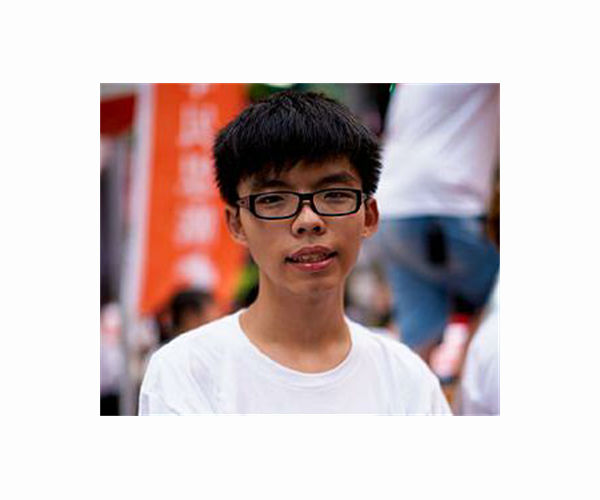
Prominent Hong Kong dissident Joshua Wong and two other leading activists pleaded guilty on Monday at the start of a trial over their involvement in last year's protests, with the trio saying they were expecting jail terms.
Hong Kong was convulsed by seven straight months of huge and often violent democracy rallies last year in which millions took to the streets.
Beijing and local authorities have refused demands for free elections and have responded with a widening crackdown against democracy supporters.
Wong, 24, was prosecuted alongside fellow activists Ivan Lam and Agnes Chow over a protest which took place last summer outside the city police headquarters.
"We three have decided to plead guilty to all charges," Wong told reporters before the trial began on Monday. "It will not be surprising if I am sent to immediate detention today."
"We will continue to fight for freedom — and now is not the time for us to kowtow to Beijing and surrender," he added.
"We have no regrets," added Lam, 26.
– Eggs and graffiti –
Inside court Wong pleaded guilty to inciting and organising an illegal assembly. Lam pleaded guilty to incitement while Chow, 23, admitted inciting and joining the protest.
The charges carry up to five years in jail, although three years is the maximum a magistrate court can hand down.
Police became a target for demonstrators after tear gas and rubber bullets were routinely used to clear crowds when rallies kicked off last June.
The force's headquarters was besieged on multiple occasions with crowds hurling eggs and daubing its walls with graffiti.
Chow had previously said she planned to plead guilty, a tactic which can lead to a lighter sentence.
Wong and Lam had originally vowed to fight the charges.
But Wong changed course, announcing his plan to plead guilty on Facebook late Sunday.
– Youthful leaders –
Despite his youth, Wong has already spent time in prison for leading democracy protests.
He became an activist when he was in his early teens, organising successful rallies in 2012 against plans to make Hong Kong's education system more 'patriotic' and similar to the mainland.
Lam and Chow joined the same movement as teens.
In 2014 they helped inspire and lead the "Umbrella Movement" — a 79-day peaceful occupation of three busy intersections by a largely student-led campaign calling for universal suffrage.
Wong was jailed for his involvement in those protests, alongside most of that movement's main leaders.
When last year's much larger democracy protests kicked off, Wong was still in jail.
He vowed to continue fighting for democracy on his release and made appearances at numerous rallies throughout the year.
However the protests were deliberately leaderless, mostly organised by social media and encrypted chat forums.
They were also much more violent. Riot police unleashed thousands of rounds of tear gas and rubber bullets and were frequently filmed using batons to beat arrested demonstrators.
Small groups of hardline activists resorted to rocks, petrol bombs and even bows and arrows.
– Arrests and gatherings banned –
More than 10,000 people were arrested and Hong Kong's courts are now filled with trials. Most of the city's leading activists and opposition figures face prosecution.
The demonstrations petered out at the start of the year thanks to fatigue, mass arrests and the emergence of the coronavirus.
An anti-pandemic ban on more than four people gathering in public has remained in place for most of this year.
Beijing has also imposed a broad security law which ramps up its direct control over the semi-autonomous city and outlaws certain political views.
Demosisto, the pro-democracy party that Wong, Lam and Chow were in, disbanded when the security law came in because their policy of pushing for greater self-determination for Hong Kong was now illegal.
Opposition lawmakers have also been disqualified and local legislature elections delayed for a year.
Authorities say they have returned much needed stability to the global trade hub.
Critics counter that none of the underlying causes of the unrest have been addressed, and that opposition to Beijing's rule remains widespread despite the lack of street protests.
UK considers withdrawing judges from top Hong Kong court
London (AFP) Nov 24, 2020 –
Britain is considering whether to review a deal allowing its judges to sit on Hong Kong's highest court over concerns China is trampling on the semi-autonomous city's freedoms, its foreign minister said.
A sweeping national security law and the purge of pro-democracy lawmakers had raised "serious" questions over China's pre-handover promise to let the financial hub maintain certain freedoms and autonomy until 2047, Dominic Raab said Monday.
"This has been, and continues to be, the most concerning period in Hong Kong's post-handover history," Raab said in the UK parliament's latest six-monthly report on the former British colony.
He added he had begun consultations "concerning when to review whether it continues to be appropriate for British judges to sit as non-permanent judges on the Hong Kong Court of Final Appeal".
Under a "One Country. Two Systems" deal Hong Kong maintained its independent, common law judiciary — viewed as one of the bedrocks of the financial hub's identity and economic success.
It is a key factor differentiating the city from mainland China where the opaque legal system is controlled by the Communist Party.
Under the Basic Law — Hong Kong's mini-constitution — senior judges from common law jurisdictions are able to sit as non-permanent members of the city's Court of Final Appeal.
If Britain were to pull its judges, it may add pressure to allies like Australia and Canada to do the same.
Western countries say Beijing has prematurely shredded its pre-handover promises with its clampdown, including a broadly worded national security law that was imposed directly on the city in June.
London has angered Beijing by offering Hong Kongers holding British National Overseas passports a route to UK citizenship by relaxing entry and residency requirements.
It has also suspended its extradition treaty with Hong Kong, one of a number of countries to do so.
China says the security law and prosecution of critics is needed to restore stability after last year's huge and often violent protests.
In a response to the latest parliamentary report, China's foreign ministry office in the city said Britain should "wake up from colonial nostalgia and stop interfering in Hong Kong affairs".
Hong Kong's government dismissed the report as "sweeping attacks and groundless accusations."
