
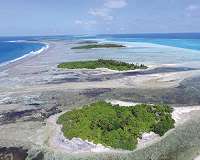
Marine heatwaves are killing coral reefs far more quickly than previously believed, according to a new study released on Friday.
Scientists have known that rising sea temperatures blamed on global warming can severely damage reefs through a process of "bleaching," where the high temperatures kill the colourful algae covering and nourishing coral.
Repeated "bleaching events", such as ones which hit Australia's Great Barrier Reef in 2016 and 2017, can eventually kill the coral in a process which takes months or years.
If sea temperatures ease, bleached corals are able to regenerate.
But the new study found that severe marine heatwaves can actually degrade the skeletal structure of the coral, potentially killing the organisms in a matter of days or weeks.
"The severity of these heatwave events is beyond the bleaching process, it's actually a point where the coral animal itself is dying," said Tracy Ainsworth, a co-author of the study from the University of New South Wales.
The study, which also involved researchers from the University of Newcastle in Britain, Australia's James Cook University, the University of Technology Sydney and the US National Oceanic and Atmospheric Administration, used CT scans of coral reefs to monitor the impact of extreme temperatures.
Scott Heron from James Cook University said the rapid dissolving of coral skeletons after severe heatwaves came as a surprise.
"Climate scientists talk about 'unknown unknowns' — impacts that we haven't anticipated from existing knowledge and experience," he said.
"This discovery fits into this category. As we begin now to understand this impact, the question is how many more of these 'unknown unknowns' might there still be that could bring faster and greater damage to coral reefs from climate change," he said.
Coral bleaching in 2016-2017 affected up to half of the coral in the 2,300-kilometre (1,400-mile) reef, a UN-listed World Heritage site off the east coast of Australia.
Australian coal use an 'existential threat' to islands: Fiji PM
Suva, Fiji (AFP) Aug 12, 2019 –
Fiji on Monday challenged Australia to do more on climate change ahead of a regional summit of Pacific nations this week, warning Canberra's reliance on coal posed an "existential threat" to low-lying islands.
Prime Minister Frank Bainimarama said Australia should recognise the threat climate change poses to Pacific island nations.
"I appeal to Australia to do everything possible to achieve a rapid transition from coal to energy sources that do not contribute to climate change," he told a function in Tuvalu, which will this week hold the annual Pacific Islands Forum.
Some low-lying Pacific island nations are threatened by rising seas, while others are pummelled by cyclones that have become more regular and powerful due to climate change.
There has been disquiet in the Pacific that Australia — led by climate-sceptic Prime Minister Scott Morrison — recently approved the giant Adani coal mine in Queensland state.
"We face an existential threat that you don't face and challenges we expect your governments and people to more fully appreciate," Bainimarama said.
He added: "Put simply, the case for coal as an energy source cannot continue to be made if every nation is to meet the net zero emission target by 2050."
Smaller members of the 18-nation Pacific Islands Forum have been unusually vocal in criticising Australia's climate policies ahead of this year's summit amid a diplomatic push from Canberra to counter China's growing influence in the region.
High-level representatives from the likes of Tuvalu, Palau and Vanuatu have criticised their powerful neighbour for not doing enough to halt global warming.
Bainimarama, who seized power in a 2006 military coup but has since reinvented himself as a climate campaigner, is making his first appearance at the forum in a decade.
He has been sharply critical of Australia in the past and is unlikely to let Morrison's concerns, which centre on Beijing's activities, to dominate the Pacific Islands Forum agenda at the expense of climate change.
Oxfam Australia's climate change adviser Simon Bradshaw said the summit in Tuvalu was shaping as a key test for Canberra.
"If Australia is to remain a trusted partner to the members of the Pacific family, and with that retain the ability to help shape the region's future, it must immediately step up its response to the number one priority of its neighbours — climate change," Bradshaw said.
The Pacific Islands Forum summit will officially open on Tuesday and continue until Thursday.
