
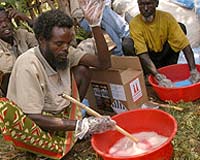
AIDS is bad, avian flu could become bad – but 2,000 children a day dying from malaria is very bad indeed. That's why Bill Gates, through the foundation set up by him and his wife, Melinda, has just given $258.3 million to help prevent and control malaria.
"For far too long, malaria has been a forgotten epidemic," said Gates, the bizillionaire founder of Microsoft who is pouring money into worldwide disease control. "It's a disgrace that the world has allowed malaria deaths to double in the last 20 years, when so much more could be done to stop the disease."
The money will be split three ways:
– $107.6 million to the PATH Malaria Vaccine Initiative (MVI). The money will allow GlaxoSmithKline Biologicals to work with African investigators to complete tests and apply for approval of an anti-malaria vaccine.
– $100 million to the Medicines for Malaria Venture (MMV) to help move promising drugs through the approval process.
– $50.7 million to the Innovative Vector Control Consortium (IVCC), led by the Liverpool School of Tropical Medicine. That money will go to developing better insecticides and other mosquito-control measures.
"Millions of children have died from malaria because they were not protected by an insecticide-treated bed net, or did not receive effective treatment," Gates said. "If we expand malaria control programs, and invest what's needed in R&D, we can stop this tragedy."
Malaria claims 2.7 million lives a year, three-fourths of them African children.
On the bird-flu front, bad news keeps rolling in along with efforts to prevent a human-to-human pandemic that could kills millions.
Thailand confirmed its 20th case of bird flu in a suburban Bangkok woman. China said it was increasing surveillance of migratory birds and poultry and had canceled pigeon races.
In Australia, the foreign minister warned Asian countries not to cover up bird-flu cases. Alexander Downer spoke at a forum on bird flu in Brisbane Monday.
While they are unrelated, concerns about the good old-fashioned flu are increasing as well as winter looms. USA Today reports that "vaccine experts are considering recommending annual flu vaccine not just for those at highest risk of serious illness, but for everyone."
Before that happens, kinks in the supply chain will need to be worked out and production jacked up considerably. "Some doctors say the real question is getting vaccine, even for their high risk patients," the newspaper said. One plant in France, shut down last year after concerns about contamination, is up and running but now is dealing with production delays.
Where there's anxiety, there's a chance to capitalize on it. The Baytown (Texas) Sun reported that the owner of a Houston healthcare company is in jail "after his company issued more than 1,000 fake flu shots to local Exxon Mobil workers during a safety fair last week."
Let's hope the placebo effect kicks in.
