
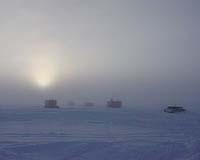
U.S. scientists in Utah say they have found yet another contributing force to polar warming: haze. Arctic climate already is known to be particularly prone to global warming caused by greenhouse gases. Now, a University of Utah study finds the Arctic haze — consisting of particulate pollution from midlatitude cities — mixes with thin clouds, enabling them to become more efficient at trapping heat.
The effect makes the Arctic up to 3 degrees Fahrenheit warmer during polluted, cloudy episodes than it would be if the air was clean, concludes the study by Tim Garrett, an assistant professor of meteorology, and doctoral student Chuanfeng Zhao.
Arctic haze has been observed since the Industrial Revolution began about 1750.
Garrett said the particulate pollution modifies clouds so they warm the surface. He said the effect is most pronounced during the Arctic winter when it is dark and there is no sunlight. That's when the Arctic is most polluted because there is almost no precipitation to wash out the pollutants, and there also is a strong inversion.
The study previously appeared in the April 6 issue of the journal Nature.
Source: United Press International
