
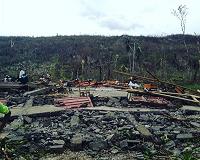
The US military and UN agencies ramped up aid deliveries to Haiti's storm-hit south on Monday, but cut roads and communications, and blockades by some starving locals, hampered efforts to reach the needy population.
The anger of many Haitians after seeing no relief a week after Hurricane Matthew hammered the southern Tiburon Peninsula was evident. Many stood by roads pleading for aid.
"I understand of course the frustration," Jean-Luc Poncelet, the country representative for the UN's World Health Organization, said after arriving at the airport outside Jeremie, one of the worst-hit cities in the south.
But, he said, the storm's impact in the south and west of the peninsula had been "really catastrophic" and it was a struggle to reach many communities.
"When you have no means of communication, no radio, no telephone, no roads and even a helicopter can't land — this is what explains the massive delay," he told AFP.
The UN's World Food Programme confirmed those same difficulties as it stepped up food handouts that started over the weekend.
"There are bridges down, the roads are complicated, there's no communications," said a WFP spokesman, Alexis Masciarelli, also at the airport.
He said the WFP has tapped into food stocks previously set aside for schools to give to hundreds of desperate families.
Masciarelli said 25 more tons had been moved to Jeremie for distribution, and many more were on their way by truck to Les Cayes, the other major city affected on the peninsula.
At least 1.4 million Haitians need urgent assistance, according to the UN.
Meanwhile, Haitian civil defense officials said Monday the death toll from the hurricane stood at 372.
– Tons of supplies –
At Jeremie's airport, US military transport helicopters unloaded boxes of USAID supplies.
An official at the airport who declined to be identified because he was not authorized to speak to the media said nearly 20 tons of supplies — tarpaulins, rice, cooking oil and hygiene kits — were being brought in.
That added to 47 tons already brought in by US military helicopters from the Haitian capital Port-au-Prince over the preceding two days.
But getting that and other aid to Haitians reduced to drinking unclean water and living in roofless houses will be challenging.
On a main road crossing the mountainous center of the peninsula, residents of some smashed villages used stacked-up trees, rocks and other storm debris to stop aid convoys from passing through without delivering any supplies.
"Indeed, there are blockades on the road and we've been able to discuss with the local community" to be allowed through, Poncelet said.
– 'Anxious' population –
A priority was to verify reported cases of cholera.
The potentially fatal waterborne disease has killed 10,000 people in Haiti since 2010, when it was inadvertently introduced by Nepalese UN peacekeepers whose camp latrine emptied into a major river.
While some towns and villages reported an apparent spike in infections since the storm, Poncelet said "the number of cases of cholera that we have confirmed are low."
He declined to give a number, but said there were "tens" of cases in one area of the peninsula.
Still, he said WHO had to "be careful" about cholera — and other diseases that cause diarrhea that could lead to dangerous fluid loss.
Though evaluation teams were still working to get a precise picture of the health situation, medical supplies were being brought in for quicker distribution, he said.
"The population is very anxious," Poncelet said. "They haven't had any systematic support over the last days," he said.
"It is indeed a very, very long time."
